 SnowScope
Kitzbühel snow, honestly: a low resort read height by height, and when to book
Kitzbühel has one of the great names in skiing, and one of the lower ski areas among the famous Alpine resorts. Both things are true at once. This piece does not sell the town or talk it down: it reads the snow of 46 past winters from our model at three heights and turns it into a booking decision.
See the live snow forecast for KitzSki in the SnowScope appSnow depth, powder alerts and the 3D map, free.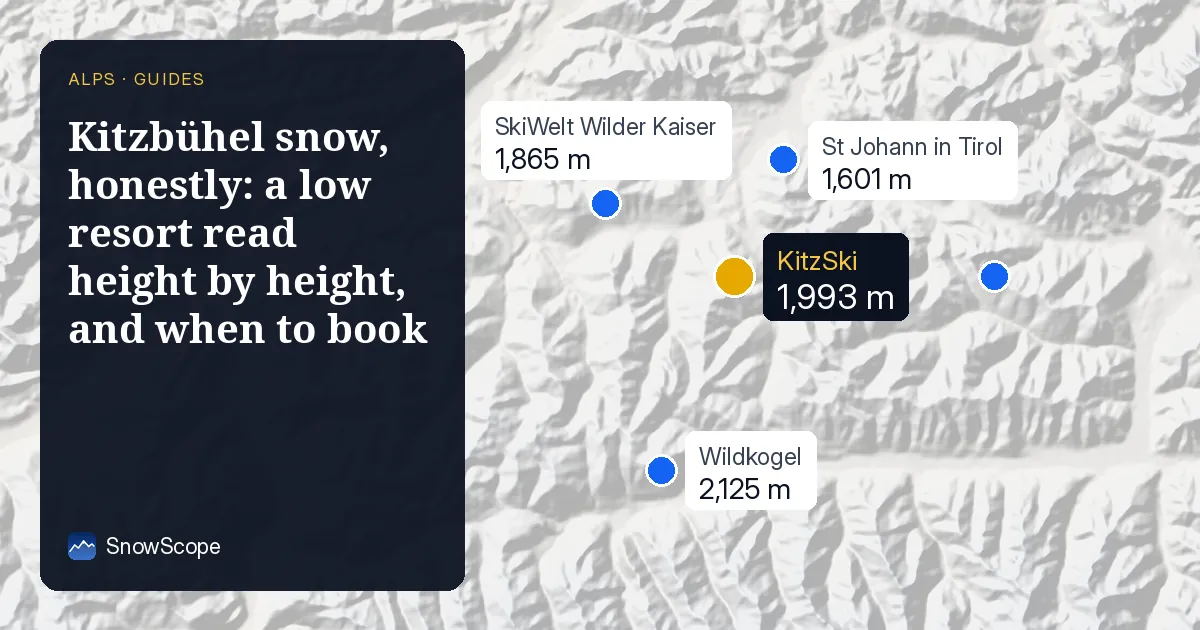
The headline first
The town lies at 762 m. The lifts we map climb to about 1,993 m, close to the Kitzbüheler Horn at 1,996 m. That is a vertical of about 1,230 m, but most of it sits below the heights where snow is reliable in the eastern Alps. KitzSki itself is large, with 233 km of runs and 57 cable cars and lifts across Kitzbühel, Kirchberg and Mittersill, so the question is not whether there is enough terrain. It is where the snow is.
Three heights, three different winters
At 762 m, in the valley, a typical winter in our record peaks at only about 30 cm, and even the snowiest of our 46 winters reached about 56 cm. The usual depth in January is about 16 cm, about 20 cm in February. Treat valley snow as a bonus, not a plan.
At 1,377 m, mid-mountain, the picture improves: about 23 cm in December, 39 cm in January, 53 cm in February and 49 cm in March in a typical winter, with a usual peak of about 65 cm. Even so, not one week of the season had 50 cm there in 9 winters out of 10.
At 1,993 m, near the top, it is a different place: about 74 cm in January, 102 cm in February and 111 cm in March, with a usual peak of about 134 cm and 12 weeks with at least 50 cm in 9 winters out of 10. In practice, the upper lifts carry a Kitzbühel holiday in a thin winter.
What the Streif says about heights
Kitzbühel hosted its first ski race in 1894, and the Streif on the Hahnenkamm, introduced in 1937, is counted among the toughest downhill courses in the world. Its fame has little to do with deep natural snow. A race piste is a prepared strip of ice; a week of holiday skiing depends on the snow around it, and that is the part our numbers describe.
What has changed
The low slopes have lost the most. At 762 m the median peak was about 34 cm in our first fifteen winters from 1980-81 and about 23 cm in the last fifteen, and the days with snow on the ground fell from about 144 to 119. At 1,377 m the peak fell from about 70 cm to about 60 cm. Near the top the change is smaller, from about 144 cm to about 134 cm. Last winter, 2025-26, was a warning: the valley peaked at about 14 cm and had snow on the ground for about 50 days.
So when should you book?
Book from late January to mid-March. The best single week at mid-mountain in our record falls in early March, and even then it had 50 cm in only about 63 % of winters, so keep some flexibility. Christmas and early December are a gamble below the upper lifts. Beginners have one advantage here: all 10 practice lifts in the valley are free to use, which helps when there is snow on them. Before you go, check the official site for lifts, and read the avalanche bulletin for Tyrol if you plan to leave the pistes.
Tips for skiers
- Plan your skiing around the upper lifts: near 1,993 m the usual peak is about 134 cm.
- Late January to mid-March is the safer window; keep dates flexible if you can.
- Valley snow at 762 m is a bonus, not a plan.
- Snow on our map does not mean a resort is open: check the lifts on the official website.
References and credits
- Wikipedia, 'Kitzbühel', retrieved 8 November 2026: town height, Kitzbüheler Horn, first ski race of 1894, Streif introduced in 1937. en.wikipedia.org/wiki/Kitzb%C3%BChel
- KitzSki, official website: 233 km of runs, 57 cable cars and lifts, free practice lifts in the valley, retrieved 8 November 2026. www.kitzski.at/en/
- Avalanche.report, official avalanche bulletin used for Tyrol. avalanche.report/
About these numbers
Snow numbers: SnowScope snow history, 46 past winters (1980-81 to 2025-26) at three heights of the resort, a model of the past corrected for height (an estimate for an area, not resort reports). Lift, run and access facts: the sources listed below, checked on the date shown.
Official avalanche bulletins: Avalanche.report – Euregio Tyrol
Cite this report
For research, teaching or the press: the numbers and charts are free to reuse under CC BY 4.0 with this citation.
SnowScope (2026), Kitzbühel snow, honestly: a low resort read height by height, and when to book, https://snowscope.app/blog/en/2026/11/kitzbuehel-snow-honestly-low-resort-when-to-book.html, accessed 2026-11-09
SnowScope (Atlas Labs). (2026, November 9). Kitzbühel snow, honestly: a low resort read height by height, and when to book. SnowScope snow reports. https://snowscope.app/blog/en/2026/11/kitzbuehel-snow-honestly-low-resort-when-to-book.html
BibTeX
@misc{snowscope2026kitzbuehelsnowhonestlylo,
  author       = {{SnowScope (Atlas Labs)}},
  title        = {Kitzbühel snow, honestly: a low resort read height by height, and when to book},
  year         = {2026},
  month        = nov,
  howpublished = {\url{https://snowscope.app/blog/en/2026/11/kitzbuehel-snow-honestly-low-resort-when-to-book.html}},
  note         = {Published 2026-11-09 20:17 UTC; accessed 2026-11-09}
}· CC BY 4.0 · Methods, data and tools →
KitzSki: snow and temperature by height, this winter vs last (tools) →
Follow KitzSki
Free: a message when fresh snow is coming, and the forecast every morning.

More snow reports
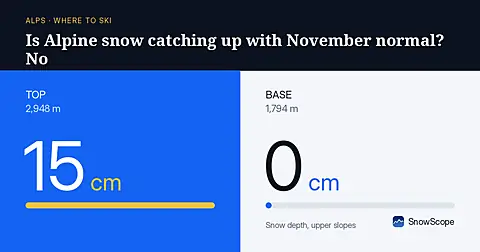
Alpine snow depths are running behind normal for early November, with only 55 cm at the best resorts as of November 3rd.
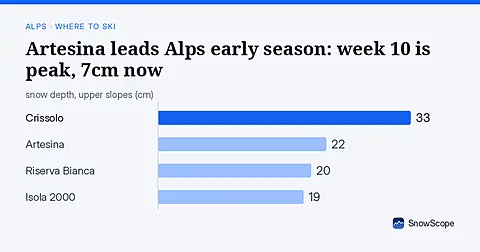
Artesina holds the deepest snow in the Alps this weekend with 22 cm upper slopes. Week 10 sees the best conditions historically. Data from 5 November.
A walk-through of the Sella Ronda from Sëlva in Val Gardena: Gardena, Campolongo, Pordoi and Sella passes in order, with our snow history of 46 past winters.