 SnowScope
Magic Mountain, Vermont: five things to know before you go
Magic Mountain is the kind of ski area people describe with affection rather than statistics: independent, steep for its size, and proud of it. It sits in Londonderry, in southern Vermont. If you are planning a first visit, these five points, with our snow history (a model of 46 past winters, not resort reports), will help you pick the right day and the right expectations.
See the live snow forecast for Magic Mountain Ski Area in the SnowScope appSnow depth, powder alerts and the 3D map, free.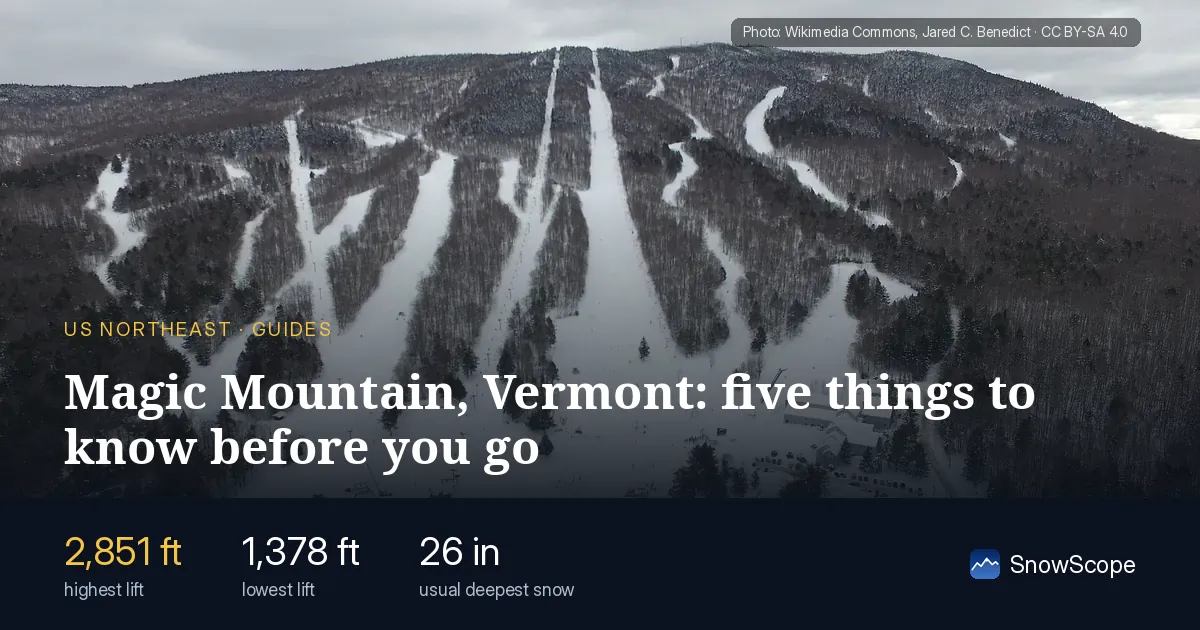
1. Natural snow is thin here, so follow the storms
Southern Vermont is not a deep-snow region. In our model, even near the top of the hill, at 2,851 ft (869 m), the usual season peak is only about 26 in (67 cm), and at the base, 1,378 ft (420 m), about 21 in (54 cm). Winters swing widely: the thinnest in our record peaked at about 6 in (14 cm), the deepest near the top at about 46 in (116 cm). Snowmaking covers about half of the terrain, so the groomed runs work more often than these numbers suggest; for the trees, you want natural snow. The best plan is to go in the days right after a good storm.
2. The steep glades are the point
Magic Mountain has the most extensive tree-skiing network in southern Vermont, with pitches reaching 45 degrees, on a vertical of about 1,500 ft from a base at 1,350 ft to a summit at 2,850 ft. There are 39 trails on 205 acres. For confident skiers that is the attraction; for beginners, there is less here than at the big resorts nearby, so pick lessons and easy runs carefully.
3. Ride the Red Chair at least once
The Red Chair is a fixed double chairlift built in 1971, slow and a little cold, and part of the hill's identity. Since 2020 the Black Line Quad gives a second way up. On a cold, windy day, dress for a long ride: a face cover and warm gloves make a big difference.
4. Pick February or early March
Near the top a typical winter has about 6 in (14 cm) in December, 11 in (28 cm) in January and about 17 in (43 cm) in February, then about 17 in (42 cm) in March. The best single week of our record, in early March, has at least 20 in (50 cm) there in half of all winters. December trips depend on snowmaking and cold nights; February and early March give the trees their best chance.
5. Know the story
The Swiss ski instructor and filmmaker Hans Thorner founded the area because the terrain reminded him of the Alps at home, and it once formed Vermont's 'Golden Triangle' with Stratton and Bromley. It closed in 1991, reopened in 1997, struggled through several owners and was reopened by Ski Magic LLC in late December 2016. Small hills like this survive on their regulars. In our record its snow has not declined: the median peak near the top was about 21 in (54 cm) in our first fifteen winters and about 25 in (63 cm) in the last fifteen, and last winter, 2025-26, was about normal at about 26 in (66 cm).
Tips for skiers
- Go in the days right after a good storm, especially for the glades.
- February and early March give the best natural snow.
- Dress warmly for the slow Red Chair: face cover, warm gloves.
- Snow on our map does not mean a resort is open: check operating days and lifts on the official website.
References and credits
- Wikipedia, 'Magic Mountain Ski Area' (retrieved 8 November 2026): location, elevations, trails, acres, lifts, glades, snowmaking, founder, closures and reopenings. en.wikipedia.org/wiki/Magic_Mountain_Ski_Area
- avalanche.org, US avalanche centers and forecasts. avalanche.org/
About these numbers
Snow numbers: SnowScope snow history, 46 past winters (1980-81 to 2025-26) at three heights of the resort, a model of the past corrected for height (an estimate for an area, not resort reports). Lift, run and access facts: the sources listed below, checked on the date shown.
Official avalanche bulletins: avalanche.org (US national portal)
Cite this report
For research, teaching or the press: the numbers and charts are free to reuse under CC BY 4.0 with this citation.
SnowScope (2026), Magic Mountain, Vermont: five things to know before you go, https://snowscope.app/blog/en/2026/11/magic-mountain-vermont-five-things-before-you-go.html, accessed 2026-11-09
SnowScope (Atlas Labs). (2026, November 9). Magic Mountain, Vermont: five things to know before you go. SnowScope snow reports. https://snowscope.app/blog/en/2026/11/magic-mountain-vermont-five-things-before-you-go.html
BibTeX
@misc{snowscope2026magicmountainvermontfive,
  author       = {{SnowScope (Atlas Labs)}},
  title        = {Magic Mountain, Vermont: five things to know before you go},
  year         = {2026},
  month        = nov,
  howpublished = {\url{https://snowscope.app/blog/en/2026/11/magic-mountain-vermont-five-things-before-you-go.html}},
  note         = {Published 2026-11-09 16:24 UTC; accessed 2026-11-09}
}· CC BY 4.0 · Methods, data and tools →
Magic Mountain Ski Area: snow and temperature by height, this winter vs last (tools) →
Follow Magic Mountain Ski Area
Free: a message when fresh snow is coming, and the forecast every morning.

More snow reports
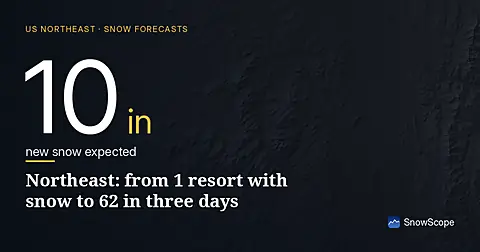
Northeast forecast made 10 November: 10 in (25 cm) of new snow arriving through 13 November will transform snow cover from 1 resort to 62.
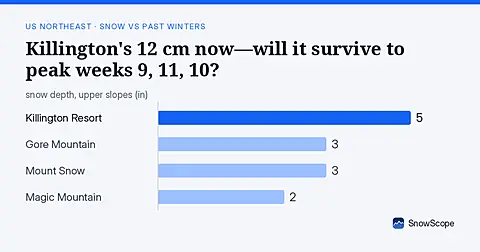
As of 13 November, Killington's 12 cm is ahead of 42 past winters at this date; peak weeks typically arrive weeks 9, 11, and 10.
A practical kit list for Stowe, Vermont: layers, face cover, goggles, sharp edges and hand warmers, tied to the snow of 46 past winters on Mount Mansfield.