 SnowScope
Big Sky in perspective: how big the mountain is, and how its snow changes with height
Numbers about Big Sky are easy to quote and hard to picture. Thousands of acres, hundreds of trails, one pyramid-shaped summit. This piece tries to put the size into everyday terms, then shows what our snow history (a model of 46 past winters, not resort reports) says about the snow from the base to the top of Lone Mountain.
See the live snow forecast for Big Sky Resort in the SnowScope appSnow depth, powder alerts and the 3D map, free.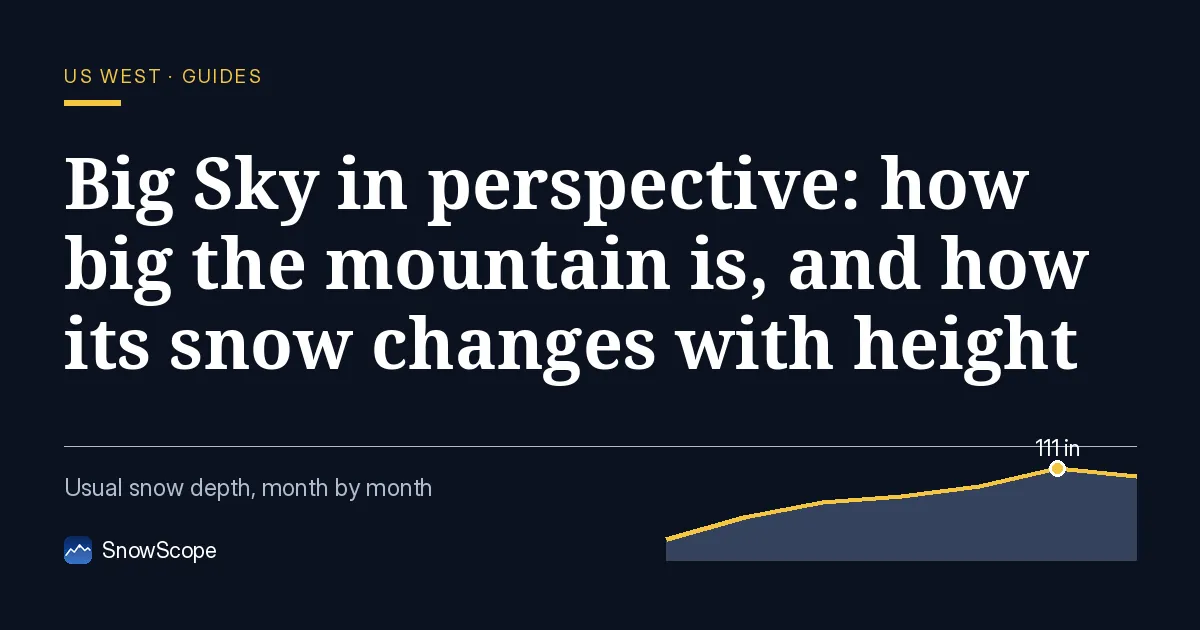
The area: a small town of terrain
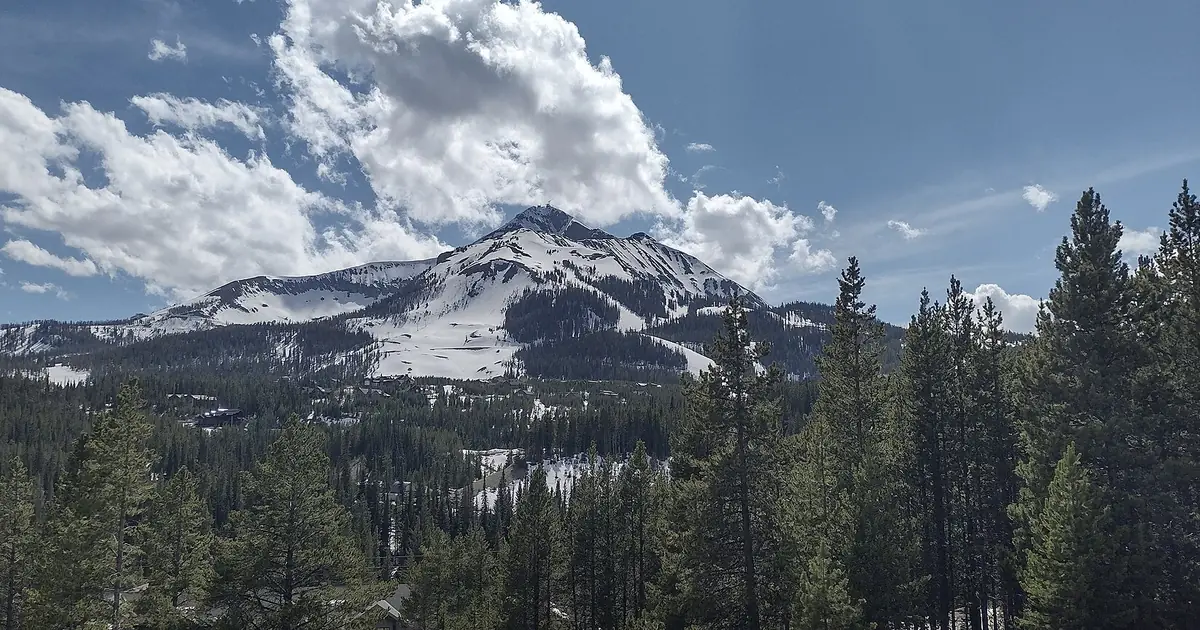
Big Sky covers about 5,850 acres, or 9.1 square miles (23.7 km²) of skiable terrain. That is the size of a small town, served by 40 lifts and more than 320 trails. In practice it means you can ski for a week and rarely repeat a run, and that the far corners of the area can be a long way from where you started. Plan your last lift back to your base before lunch, not at 3 pm.
The height: one summit above everything
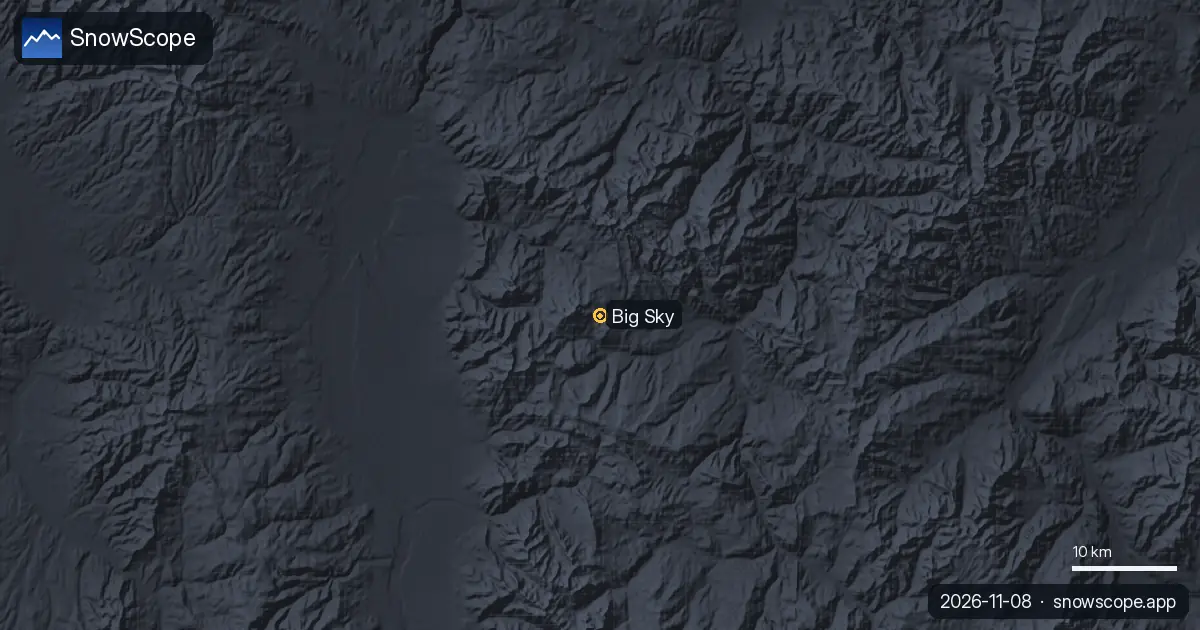
The top of Lone Mountain stands at 11,166 ft (3,403 m), and the resort's vertical drop is about 4,350 ft (1,330 m). Picture three or four tall office towers stacked on top of each other, then cover them with snow. The Lone Peak Tram, with two cabins of up to 75 people, carries skiers to the very top; below it, the mountain spreads out in bowls, glades and long groomed runs.
The snow: base and top are two different worlds
Height changes everything. In our model, the base at 6,818 ft (2,078 m) reaches a usual season peak of only about 28 in (71 cm). Mid-mountain, at 8,990 ft (2,740 m), gets about 82 in (208 cm), and near the summit, at 11,161 ft (3,402 m), about 137 in (347 cm): roughly five times as much as at the base. The upper mountain also stays white for longer, with snow on the ground on about 251 days of a typical winter.
The season: long at the top, short at the bottom
At mid-mountain a typical winter has about 34 in (86 cm) in December, 47 in (120 cm) in January, 56 in (141 cm) in February, 61 in (156 cm) in March and 66 in (168 cm) in April, the deepest month. Near the top the snow keeps building into April, at about 111 in (281 cm), and is still about 101 in (256 cm) in May. Mid-mountain keeps at least 20 in (50 cm) for 23 weeks in 9 winters out of 10. The base is the weak point: the lowest runs are best from late January to March.
Big winters and smaller ones
The range is wide. Near the top, the thinnest winter of our record peaked at about 99 in (252 cm) and the deepest at about 276 in (700 cm). Last winter, 2025-26, reached about 114 in (290 cm) there, below the usual level. Over time the snow has thinned: the median peak near the top fell from about 160 in (406 cm) in our first fifteen winters to about 124 in (316 cm) in the last fifteen, and at mid-mountain from about 94 in (238 cm) to about 76 in (194 cm).
Getting there and staying safe
Big Sky was founded by the Montana broadcaster Chet Huntley and opened in December 1973. It lies about 50 miles (80 km) from Bozeman. The upper mountain is steep, exposed alpine terrain: read the Gallatin National Forest Avalanche Center forecast before you go beyond the groomed runs.
Tips for skiers
- Big area: plan your way back to your base early in the afternoon.
- For the deepest snow, ski high; the base area is best from late January to March.
- Spring trips: the upper mountain usually holds its snow into April.
- Snow on our map does not mean a resort is open: check lifts and the tram on the official website.
References and credits
- Wikipedia, 'Big Sky Resort' (retrieved 8 November 2026): acres, vertical drop, Lone Mountain, lifts, trails, Lone Peak Tram, Chet Huntley, opening in 1973, distance from Bozeman. en.wikipedia.org/wiki/Big_Sky_Resort
- Gallatin National Forest Avalanche Center, avalanche forecasts. www.mtavalanche.com/
About these numbers
Snow numbers: SnowScope snow history, 46 past winters (1980-81 to 2025-26) at three heights of the resort, a model of the past corrected for height (an estimate for an area, not resort reports). Lift, run and access facts: the sources listed below, checked on the date shown.
Official avalanche bulletins: Gallatin National Forest Avalanche Center
Cite this report
For research, teaching or the press: the numbers and charts are free to reuse under CC BY 4.0 with this citation.
SnowScope (2026), Big Sky in perspective: how big the mountain is, and how its snow changes with height, https://snowscope.app/blog/en/2026/11/big-sky-resort-size-in-perspective-lone-peak.html, accessed 2026-11-09
SnowScope (Atlas Labs). (2026, November 9). Big Sky in perspective: how big the mountain is, and how its snow changes with height. SnowScope snow reports. https://snowscope.app/blog/en/2026/11/big-sky-resort-size-in-perspective-lone-peak.html
BibTeX
@misc{snowscope2026bigskyresortsizeinperspe,
  author       = {{SnowScope (Atlas Labs)}},
  title        = {Big Sky in perspective: how big the mountain is, and how its snow changes with height},
  year         = {2026},
  month        = nov,
  howpublished = {\url{https://snowscope.app/blog/en/2026/11/big-sky-resort-size-in-perspective-lone-peak.html}},
  note         = {Published 2026-11-09 16:57 UTC; accessed 2026-11-09}
}· CC BY 4.0 · Methods, data and tools →
Big Sky Resort: snow and temperature by height, this winter vs last (tools) →
Follow Big Sky Resort
Free: a message when fresh snow is coming, and the forecast every morning.

More snow reports
Mt Baker will receive 16.5 in (42 cm) of new snow through November 8, leading the US West, based on our model run on November 5.
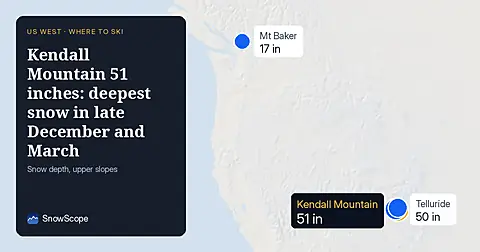
Kendall Mountain now has 51 inches on upper slopes as of November 5, 2026. Snow peaks in late December and March—the best historical windows to visit.

Heavenly, Sierra-at-Tahoe and Mt. Rose have more snow on 19 November than in any winter since 1980-81. How much fell, the measured gauges, the weather behind it and the best days to go.