 SnowScope
How white were the High Atlas mountains in winter 2025-26? 26 winters of satellite snow cover
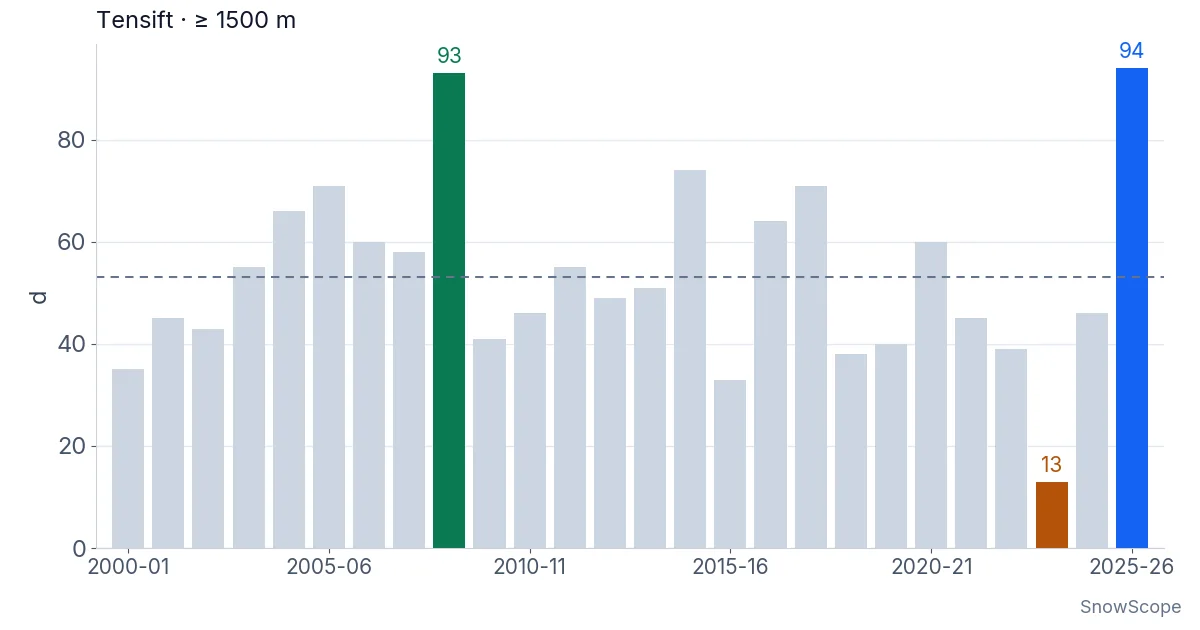
Ask anyone in the valleys south of Marrakech and they will tell you: this was a white winter. The satellite agrees. Between 1 November and 30 April, the mountains of the Tensift above 1,500 m were white for 94 days, the most of any winter since 2000-01 and close to twice the usual 53. One thing first: this article is about where the ground was white, not about how deep the snow was.
See the live snow forecast for Oukaïmeden in the SnowScope appSnow depth, powder alerts and the 3D map, free.
What a white pixel means
The images come from a NASA satellite camera that has photographed the Atlas almost every day since 2000. For each square of 500 m, NASA keeps an 8-day summary: was this square seen white at least once? We used the squares above 1,500 m in the mountain valleys that drain to the Tensift river, from the Ourika and the Rheraya to the N'Fis, a total of 3,620 km². We dropped any 8-day summary in which clouds hid more than a fifth of that area.
A white square can hold 5 cm of fresh snow or 2 m of old drifts. The camera cannot tell the difference. So everything below is about extent, how much of the mountain was white, and for how long. It says nothing about depth, and nothing about the amount of water in the snow.
Ninety-four white days
We count white days like this: for each 8-day period from November to April, a square is white or not; we add the periods up and average over all the squares. The best possible score is 184. In the 20 winters from 2000-01 to 2019-20, the middle value is 53 days.
2025-26 scored 94. Only one winter comes close: 2008-09, with 93. Third is 2014-15, far behind with 74. With a difference of one day, we would not call 2025-26 clearly the winner. Call it a tie at the top of 26 winters.
At the other end, 2023-24 had only 13 white days, by far the poorest winter in the record. 2015-16 (33), 2000-01 (35), 2018-19 (38) and 2022-23 (39) were also thin. In our second chart, 2023-24 is the short brown bar, and it makes 2025-26 look even taller.
How low the snow came
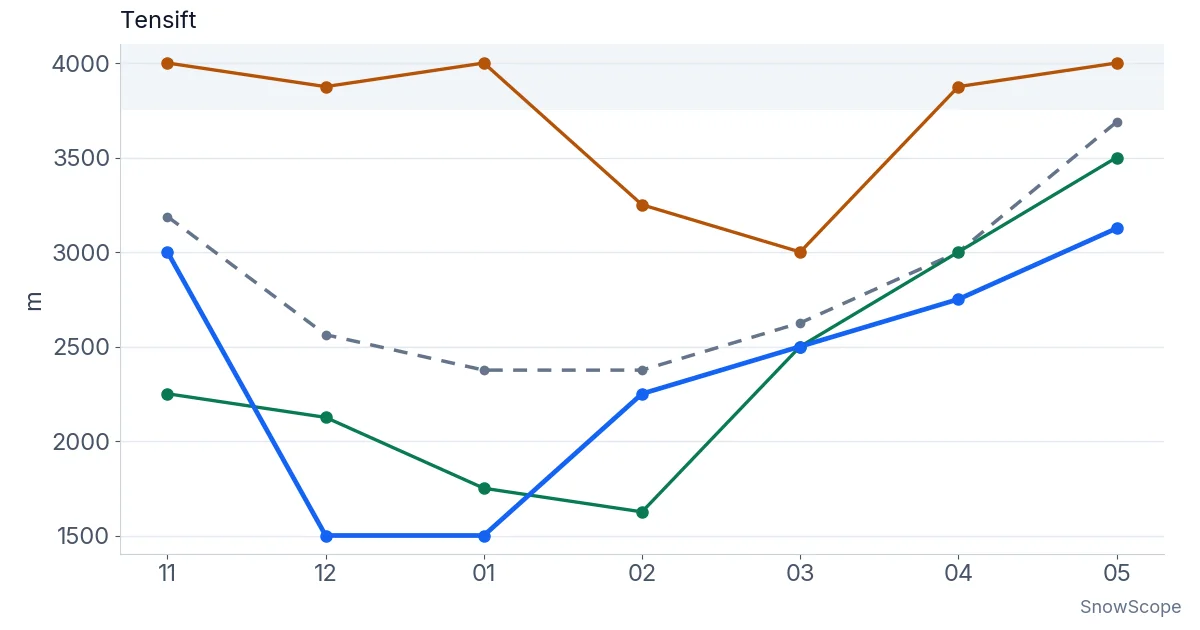
Snow cover in the Atlas is a story of height. To follow it, we split the mountains into steps of 250 m, using a terrain map, and asked for each step how much of it was white. We call the snow line the height above which every step is at least half white. It is a rough line: our steps are 250 m tall, and one snowy day in 8 is enough to count, so the true line on any given day was often higher.
In a usual winter the line sits near 2,550 m in December and 2,400 m in January and February. In December and January of 2025-26 the monthly middle value came all the way down to 1,500 m, the bottom of our area. In other words, for weeks the foothills above the villages were white too. In 2008-09 the line reached 1,750 m in January and 1,600 m in February: the same kind of winter, with the low snow a little later.
Then the line climbed with the spring sun: 2,250 m in February, 2,500 m in March, 2,750 m in April and 3,100 m in May. In a usual year the line is already near 3,000 m in April and 3,700 m in May, so last spring the snow stayed some hundreds of metres lower than normal.
When the snow left
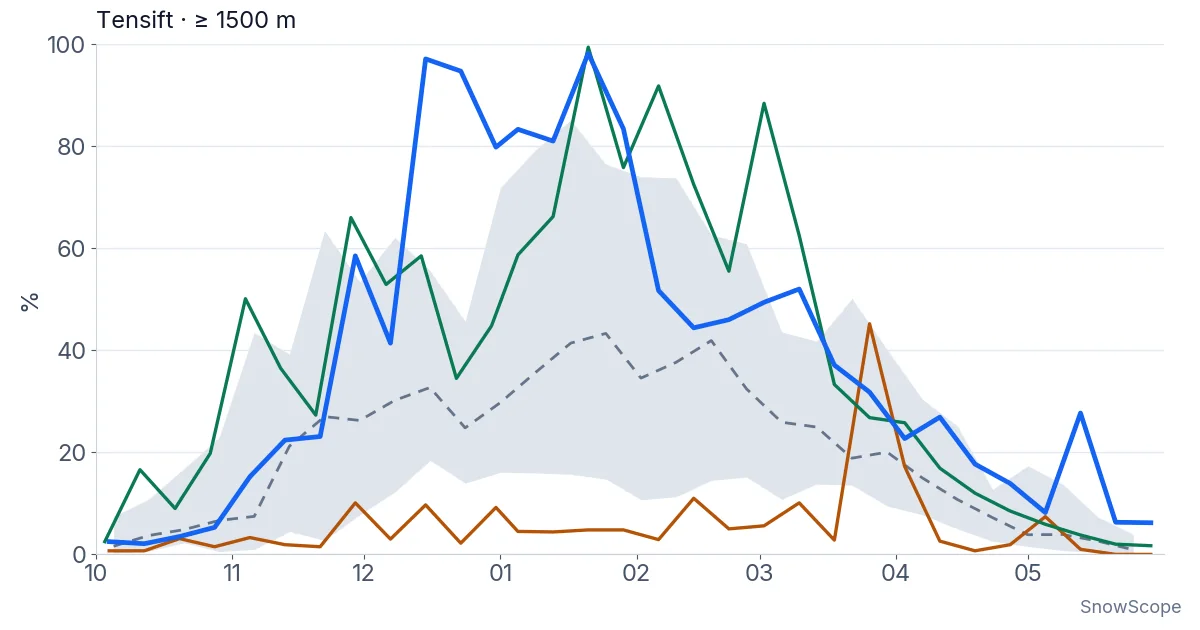
The first chart shows the white share of the mountains, 8 days at a time. In November 2025 it was thin, between 15 % and 23 %. On 11 December the season changed: in the 8 days from that date, 97 % of the mountains above 1,500 m were seen white. Until late January every 8-day summary showed at least 80 % white, and the top value, 98 %, came in the 8 days from 17 January. In a usual winter, even the best weeks are well below that.
From February the white share came down, but slowly. On 1 March it was still 49 %. The last 8-day period with at least half of the mountains white began on 6 March. In a typical winter that moment comes around 18 February, so the cover lasted about two and a half weeks longer. 2008-09 ended its half-white season on the same date, 6 March. In two of the 20 reference winters, 2003-04 and 2012-13, the mountains were never half white after New Year.
And 2023-24? Its white share stayed below a fifth almost all winter. Only a late-March storm briefly whitened 45 % of the area. Its snow line, in most months, was higher than our highest step of 3,750 m: in those months, not even the summits were half white in our 8-day summaries.
Why one winter can be so different from the next
The High Atlas gets most of its snow from a handful of Atlantic storms each winter. When they come in a series, as they did from mid-December to late January, the mountains stay white for weeks and the cold air keeps the snow line low. When the storms miss Morocco, as in 2023-24, a single late system cannot make up for the months without snow.
The terrain also matters. Only 923 km² of our area lies above 2,500 m, and only 293 km² above 3,000 m. In a dry winter those high slopes are the only white ground, so the white share of the whole area stays small. In a big winter the snow covers the much larger middle slopes too, and the number of white days jumps.
How sure are we?
Sure about the ranking: 26 winters of the same camera, processed in the same way, put 2025-26 and 2008-09 together at the top and 2023-24 clearly at the bottom. Fairly sure about the timing of the season. Less sure about the exact heights of the snow line, which come from 250 m steps and 8-day summaries. And remember what is not in this article: how deep the snow was, or how much water it held. White is white, whether it is a dusting or a deep pack.
Tips for skiers
- When the foothills look white from Marrakech, the snow line is low and the high valleys are deep in winter: plan for cold, short days and icy tracks.
- In a big winter the snow can last into March at mid-height; in a dry one, only the slopes above 3,000 m stay white.
- Snow cover on a satellite map does not tell you how deep or how stable the snow is: ask local mountain guides before going off the beaten track.
- Always check the latest weather bulletin before a trip to the high Atlas.
References and credits
- Hall, D. K. and Riggs, G. A. MODIS/Terra Snow Cover 8-Day L3 Global 500m SIN Grid, Version 61. NASA National Snow and Ice Data Center DAAC. nsidc.org/data/mod10a2/versions/61
- Copernicus DEM (GLO-90): global terrain heights, European Space Agency. doi.org/10.5270/ESA-c5d3d65
About these numbers
Snow cover: NASA MODIS Terra 8-day maximum snow extent (MOD10A2, collection 6.1, 500 m), NASA National Snow and Ice Data Center DAAC, 1 October 2000 to 8 November 2026. Area: mountain catchments of the Tensift basin, ground at or above 1,500 m (3,620 km²); heights from the Copernicus DEM GLO-90. 8-day periods with less than 80 % clear view are not used. White days = 8-day periods with snow from 1 November to 30 April x 8 (a cloudy period keeps the previous clear state), averaged over the area. Snow line = lower edge of the lowest 250 m height step from which every higher step is at least half white, monthly middle value. Usual = middle of the winters 2000-01 to 2019-20. This is snow cover (where the ground is white), not snow depth or water. All numbers: SnowScope analysis scripts, 10 November 2026.
Cite this report
For research, teaching or the press: the numbers and charts are free to reuse under CC BY 4.0 with this citation.
SnowScope (2026), How white were the High Atlas mountains in winter 2025-26? 26 winters of satellite snow cover, https://snowscope.app/blog/en/2026/11/high-atlas-snow-cover-winter-2025-26-satellite-26-winters.html, accessed 2026-11-11
SnowScope (Atlas Labs). (2026, November 11). How white were the High Atlas mountains in winter 2025-26? 26 winters of satellite snow cover. SnowScope snow reports. https://snowscope.app/blog/en/2026/11/high-atlas-snow-cover-winter-2025-26-satellite-26-winters.html
BibTeX
@misc{snowscope2026highatlassnowcoverwinter,
  author       = {{SnowScope (Atlas Labs)}},
  title        = {How white were the High Atlas mountains in winter 2025-26? 26 winters of satellite snow cover},
  year         = {2026},
  month        = nov,
  howpublished = {\url{https://snowscope.app/blog/en/2026/11/high-atlas-snow-cover-winter-2025-26-satellite-26-winters.html}},
  note         = {Published 2026-11-11 07:30 UTC; accessed 2026-11-11}
}· CC BY 4.0 · Methods, data and tools →
Oukaïmeden: snow and temperature by height, this winter vs last (tools) →
Follow Oukaïmeden
Free: a message when fresh snow is coming, and the forecast every morning.

More snow reports
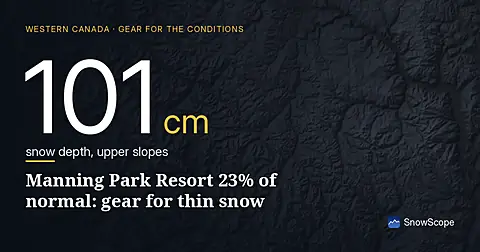
Manning Park Resort snow is at 23% of normal for mid-November. Here's what to bring for thin cover and the changing conditions ahead.
How much water the Atlas snow may hold in February 2027: the European seasonal forecast is about 3 °C warmer and wetter in the west and south, so snow odds stay low across Morocco's river basins.
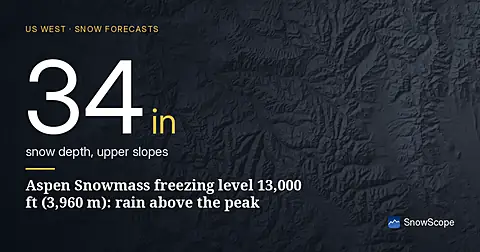
Freezing level climbs to 13,000 ft (3,960 m) at Aspen Snowmass, creating rain-on-snow risk as temperatures warm mid-November (forecast from 11 Nov data).