 SnowScope
Lake Louise in November and December: an early-season ski guide
Lake Louise, in Banff National Park, is one of the first big ski areas in Canada to get going each winter, and for decades it has opened the World Cup speed season. Early-season trips are tempting: fewer people, cold snow, long views. They also need a different mindset. Here is what to expect in November and December, with our snow history (a model of 46 past winters, not resort reports) as the guide.
See the live snow forecast for Lake Louise Ski Area in the SnowScope appSnow depth, powder alerts and the 3D map, free.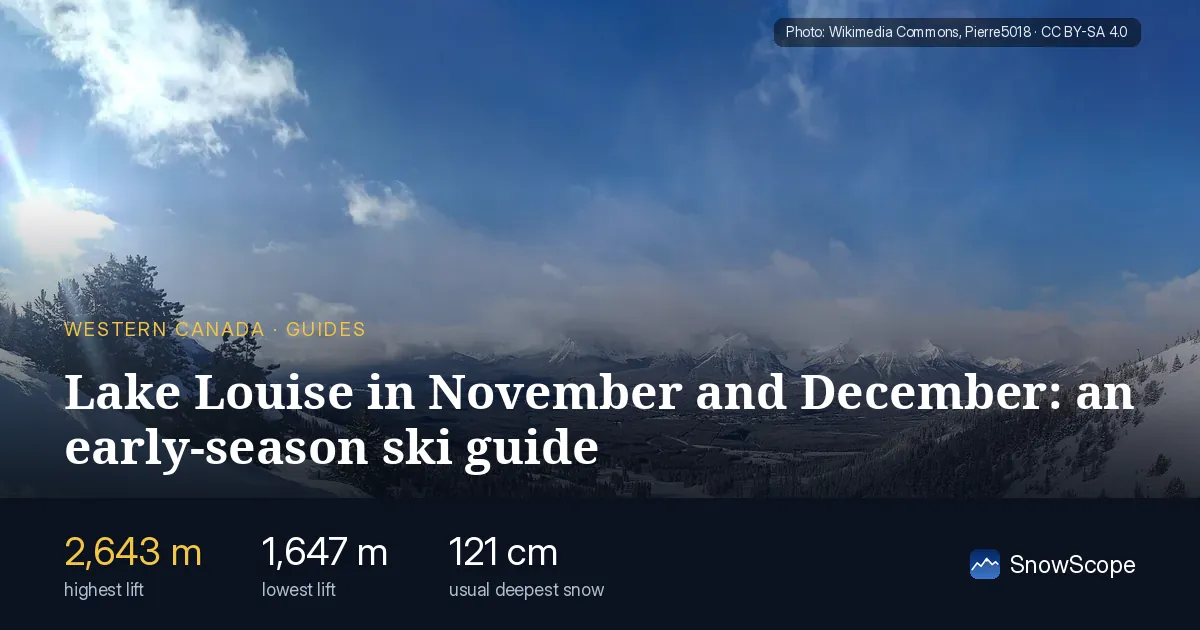
Why Lake Louise starts early
The resort hosts the season-opening downhill and super-G races of the FIS Alpine Ski World Cup, the only place in Canada where they are held. Races began in 1980 and ran every year from 1993 to 2020. Early speed races need early, reliable snow and cold, and that is the reputation of this mountain. For 2026-27 the resort's season pass is valid from 6 November 2026 to 2 May 2027 (pass dates, not a promise of open lifts), with lift hours from 9:30 am to 4:30 pm, and mentions more snowmaking at Richardson's Ridge.
What November snow looks like
In our model the snow arrives early: the first snow usually reaches mid-mountain around 23 September and the base around 2 October. By November a typical winter has about 40 cm on the ground. The range is the important part: in 1 winter out of 10 there are only about 19 cm, and in the snowiest tenth about 66 cm. In other words, November can mean a handful of groomed runs on a thin base, or a real early winter. Snowmaking does a lot of the work in the first weeks.
December: the base builds
December is when early season becomes winter. A typical December has about 73 cm, with about 44 cm in a thin year and about 100 cm in a deep one. January follows with about 89 cm, and the usual season peak, about 120 cm, comes in March. At least 50 cm lies on the ground for 19 weeks in 9 winters out of 10. A note on our numbers: at this resort our three heights give almost the same values, because our past-winters model sees the area as one snow zone, so read them as the snow of the whole area, not of one run.
How to ski early-season cover
Stay on the groomed runs that are marked open, and expect hard, fast snow in the morning. Thin cover hides rocks and stumps, so off-piste and the trees are a bad idea before the base has built up. Bring old skis or a rental pair if you worry about your edges. Days are short and cold in November: a warm mid layer and a face cover make the difference.
A record that has grown
Lake Louise has gained snow in our record. The median peak was about 113 cm in our first fifteen winters and about 131 cm in the last fifteen. Last winter, 2025-26, was the deepest of all 46, with a peak of about 164 cm. Early trips are still a bet on the weather, but recent winters have rewarded it more often.
Getting there
The ski area is about 57 km west of Banff, in the national park, and the longest run is 8 km long. Park rules apply, wildlife has right of way on the roads, and the backcountry around the resort is serious avalanche terrain: read the Avalanche Canada forecast for Banff, Yoho and Kootenay before you leave the ski area.
Tips for skiers
- November: expect a few groomed runs on a thin base, mostly made by snowmaking.
- December onwards: the base usually builds quickly; mid-December is a safer early date than November.
- Thin cover: stay on marked open runs and keep out of the trees and off-piste.
- Snow on our map does not mean a resort is open: check lifts and opening dates on the official website.
References and credits
- Wikipedia, 'Lake Louise Ski Resort' (retrieved 8 November 2026): location, World Cup history, longest run. en.wikipedia.org/wiki/Lake_Louise_Ski_Resort
- Lake Louise Ski Resort, official website (retrieved 8 November 2026): 2026-27 dates, lift hours, snowmaking. www.skilouise.com/
- Avalanche Canada / Parks Canada, avalanche forecast for Banff, Yoho and Kootenay. avalanche.ca/map/forecasts/afe9ffd14c0637d10e2530857f8e7a8cba0277f33351d3b31c8f37f4111c6ecf
About these numbers
Snow numbers: SnowScope snow history, 46 past winters (1980-81 to 2025-26) at three heights of the resort, a model of the past corrected for height (an estimate for an area, not resort reports). Lift, run and access facts: the sources listed below, checked on the date shown.
Official avalanche bulletins: Parks Canada
Cite this report
For research, teaching or the press: the numbers and charts are free to reuse under CC BY 4.0 with this citation.
SnowScope (2026), Lake Louise in November and December: an early-season ski guide, https://snowscope.app/blog/en/2026/11/lake-louise-early-season-ski-guide-november-december.html, accessed 2026-11-09
SnowScope (Atlas Labs). (2026, November 9). Lake Louise in November and December: an early-season ski guide. SnowScope snow reports. https://snowscope.app/blog/en/2026/11/lake-louise-early-season-ski-guide-november-december.html
BibTeX
@misc{snowscope2026lakelouiseearlyseasonski,
  author       = {{SnowScope (Atlas Labs)}},
  title        = {Lake Louise in November and December: an early-season ski guide},
  year         = {2026},
  month        = nov,
  howpublished = {\url{https://snowscope.app/blog/en/2026/11/lake-louise-early-season-ski-guide-november-december.html}},
  note         = {Published 2026-11-09 17:32 UTC; accessed 2026-11-09}
}· CC BY 4.0 · Methods, data and tools →
Lake Louise Ski Area: snow and temperature by height, this winter vs last (tools) →
Follow Lake Louise Ski Area
Free: a message when fresh snow is coming, and the forecast every morning.

More snow reports
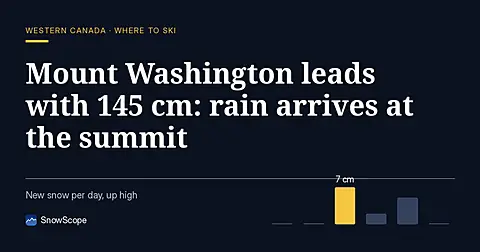
Mount Washington holds 145 cm on 8 November, the deepest in Western Canada, but the freezing level will climb above the summit by 11 November.
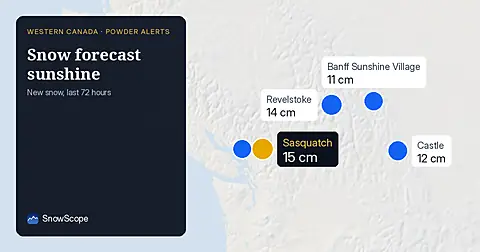
Freezing level reaches 1,500 m at Banff Sunshine Village on November 19. Fresh snow fell across Western Canada in the last 72 hours, but rain threatens the new powder.
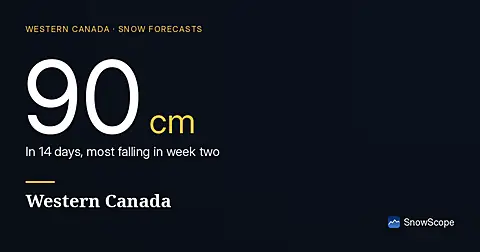
Western Canada forecast: 90 cm new snow at Mount Washington in the next two weeks, with 70 cm expected in late November and early December. Model run 2026-11-18.