 SnowScope
Sölden's snow calendar: from the first glacier snow to the last spring run
Most resorts have a season. Sölden, in Austria's Ötztal, has something closer to a calendar, because two glaciers stretch its year at both ends. Here it is phase by phase, with the snow of 46 past winters from our model at 1,346 m, 2,295 m and 3,245 m.
See the live snow forecast for Sölden in the SnowScope appSnow depth, powder alerts and the 3D map, free.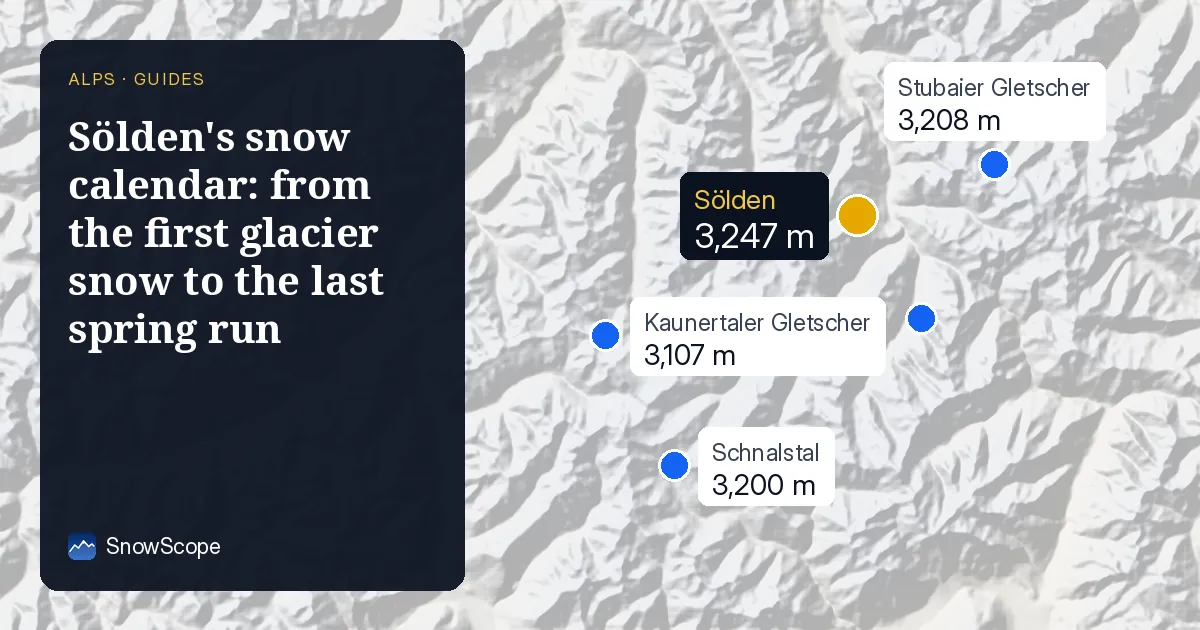

September: the glaciers turn white first
The Ötztal Glacier Road, the second highest paved road in Europe, climbs from the village, at 1,368 m, to the Rettenbach and Tiefenbach glaciers. Up there winter starts early. At 3,245 m, the top of our record, the first lasting snow of a typical winter arrives around 8 September, and at 2,295 m around 18 September. The valley waits much longer, until about 9 October.
Late October: the race weekend
Sölden regularly hosts the first World Cup races of the season, usually a giant slalom for men and for women in late October, on the glacier. It is a good moment to see the area, but not yet a ski holiday for most people: our model gives about 75 cm on average at the top in November, and only about 29 cm at mid-mountain.
November and December: high first, low later
Early winter is a story of height. By December a typical winter has about 140 cm at 3,245 m, about 62 cm at 2,295 m and about 19 cm at 1,346 m. If you come before Christmas, plan your days on the glaciers and the upper lifts and treat the runs to the village as a bonus.
January to March: the long middle
This is the heart of the season. At mid-mountain a typical winter has about 91 cm in January, 127 cm in February and 133 cm in March, its deepest month, with a usual peak of about 152 cm. In 9 winters out of 10 there were at least 50 cm there for 17 weeks. The base is the weak point all winter: even in February only about 42 cm is usual at 1,346 m.
April and early May: the glacier's best weeks
Here Sölden is unusual. At the top of our record the snow keeps building after the rest of the mountain has peaked: about 240 cm in March, about 277 cm in April and still about 258 cm in May. The best week in our 46 winters falls in early May, when every winter had at least 50 cm and the usual depth was about 291 cm. Spring skiing high up is therefore a real option, while the lower runs soften and close earlier.
June: the last snow, and what has changed
At 2,295 m the snow of a typical winter finally melts around 17 June. Over time the middle of the mountain has thinned: its median peak was about 170 cm in our first fifteen winters and about 146 cm in the last fifteen, with fewer days of snow on the ground (about 261 against 236). Near the top the median peak has stayed about the same, about 349 cm in both periods. Last winter, 2025-26, was below normal, with about 110 cm at mid-mountain.
Using the calendar
Sölden counts 147.2 km of slopes and has viewing platforms on three peaks over 3,000 m. Above it all stands the Wildspitze, at 3,768 m the second highest mountain in Austria, and the Ötzi mummy was found in the Ötztal Alps near Sölden. Glacier terrain hides crevasses: off the pistes, go with a guide and read the avalanche bulletin first. Lifts and dates change every year, so check the official website before you plan.
Tips for skiers
- Before Christmas, plan on the glaciers and the upper lifts.
- January to March is the most reliable window at mid-mountain.
- For spring snow, aim high: April and early May are the glacier's deepest weeks.
- Snow on our map does not mean a resort is open: check lifts and dates on the official website.
References and credits
- Wikipedia, 'Sölden', retrieved 8 November 2026: village height, Ötztal Glacier Road, Rettenbach and Tiefenbach glaciers, World Cup opener, Wildspitze, Ötzi. en.wikipedia.org/wiki/S%C3%B6lden
- Sölden, official website: 147.2 km of slopes, BIG3 viewing platforms on peaks over 3,000 m, World Cup Opening, retrieved 8 November 2026. www.soelden.com/
- Avalanche.report, official avalanche bulletin (Euregio, incl. Tyrol). avalanche.report/
About these numbers
Snow numbers: SnowScope snow history, 46 past winters (1980-81 to 2025-26) at three heights of the resort, a model of the past corrected for height (an estimate for an area, not resort reports). Lift, run and access facts: the sources listed below, checked on the date shown.
Official avalanche bulletins: Euregio Avalanche.report
Cite this report
For research, teaching or the press: the numbers and charts are free to reuse under CC BY 4.0 with this citation.
SnowScope (2026), Sölden's snow calendar: from the first glacier snow to the last spring run, https://snowscope.app/blog/en/2026/11/soelden-snow-calendar-glaciers-world-cup-spring.html, accessed 2026-11-08
SnowScope (Atlas Labs). (2026, November 8). Sölden's snow calendar: from the first glacier snow to the last spring run. SnowScope snow reports. https://snowscope.app/blog/en/2026/11/soelden-snow-calendar-glaciers-world-cup-spring.html
BibTeX
@misc{snowscope2026soeldensnowcalendarglaci,
  author       = {{SnowScope (Atlas Labs)}},
  title        = {Sölden's snow calendar: from the first glacier snow to the last spring run},
  year         = {2026},
  month        = nov,
  howpublished = {\url{https://snowscope.app/blog/en/2026/11/soelden-snow-calendar-glaciers-world-cup-spring.html}},
  note         = {Published 2026-11-08 21:36 UTC; accessed 2026-11-08}
}· CC BY 4.0 · Methods, data and tools →
Sölden: snow and temperature by height, this winter vs last (tools) →
Follow Sölden
Free: a message when fresh snow is coming, and the forecast every morning.

More snow reports
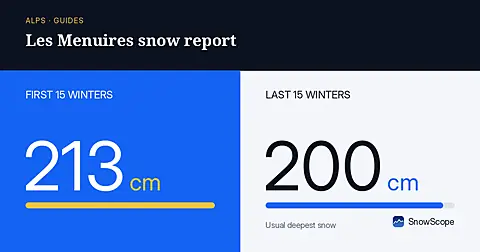
Les Menuires snow report for 13 November 2026: 28 cm at the top (2838 m), none lying at 2112 m or 1386 m. About 80 cm due at the top in seven days, snow line around 1500 to 1700 m. Why Val Thorens, 450 m higher up the same valley, already has more.
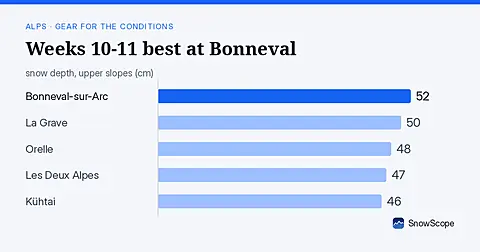
Bonneval-sur-Arc shows 52 cm upper slopes on 8 November. Weeks 10-11 are peak snow months. See what to pack for the forecast.
Is Verbier good for beginners? When is the snow best? How do you get there? Answers from the 4 Vallées and 46 past winters of snow data.