 SnowScope
St Anton snow month by month: when to ski the Arlberg
St Anton is a village of 1,304 m with a big mountain above it: the Valluga rises to 2,811 m, a vertical drop of 1,507 m. Because the village is low and the terrain high, the month you choose matters more here than in many resorts. This is the winter, month by month, through our snow history.
See the live snow forecast for St. Anton/St. Christoph/Stuben in the SnowScope appSnow depth, powder alerts and the 3D map, free.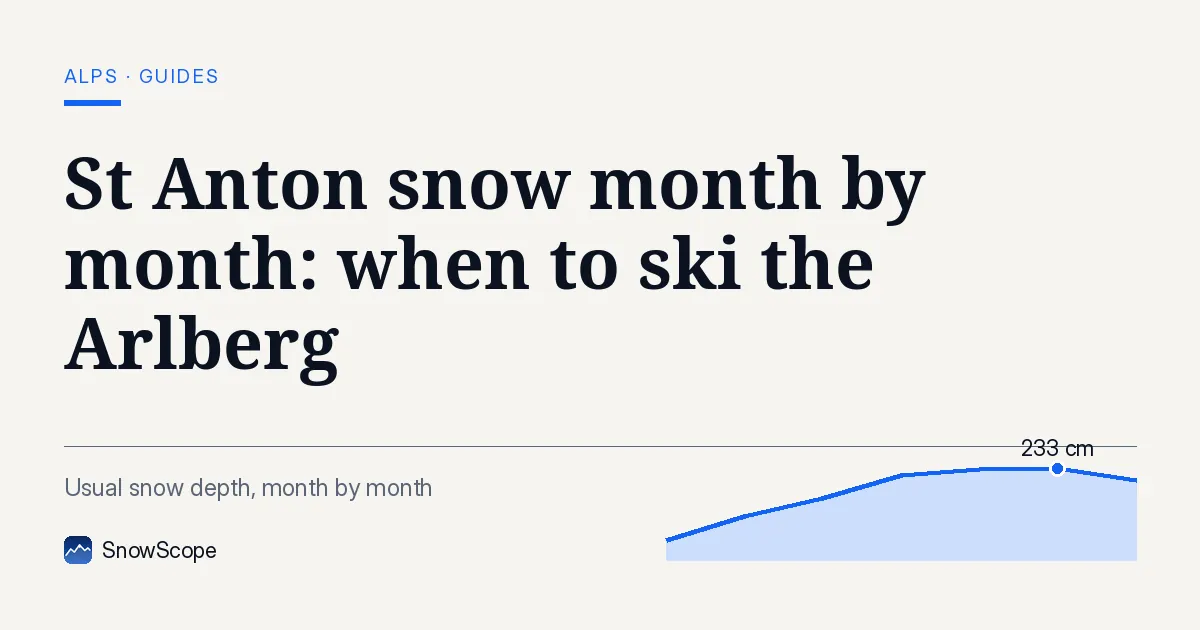
The mountain in brief
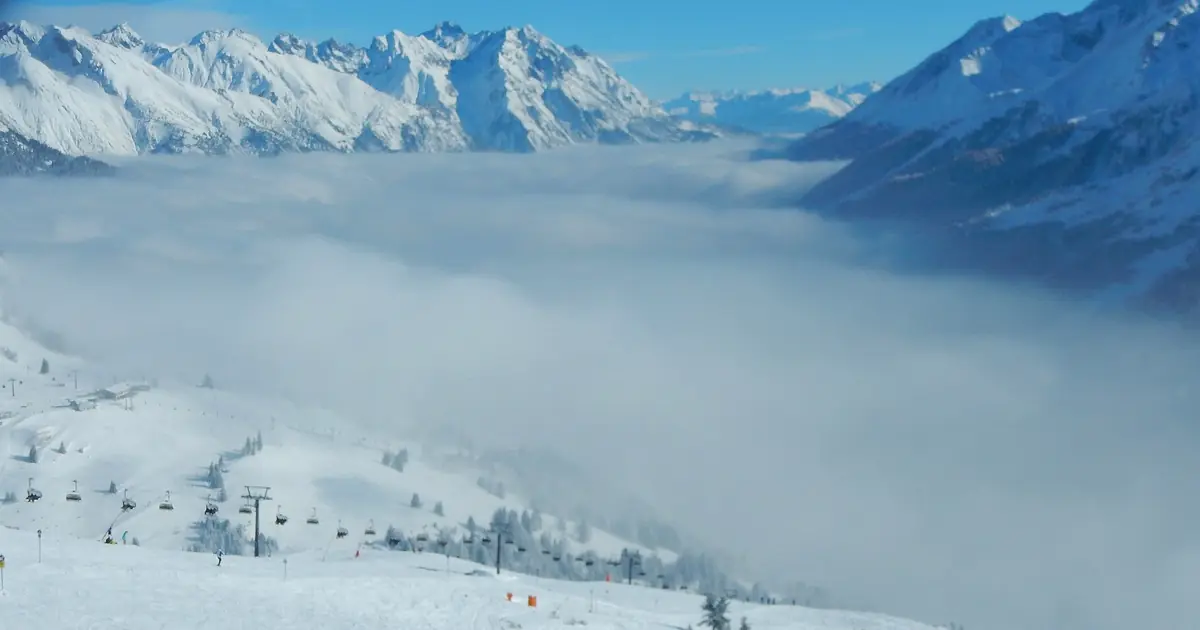
St Anton belongs to Ski Arlberg, which links it with St Christoph, Stuben, Lech and Zürs: 94 lifts and 340 km of groomed pistes in all. The village has a long skiing history; instructors from the area took the sport to the United States in the 1930s, and Hannes Schneider, a local instructor, developed the 'Arlberg technique'. St Anton hosted the Alpine World Ski Championships in 2001. It suits confident intermediates and experts best, with plenty of steep and off-piste ground.
Our numbers are model values of 46 past winters (1980-81 to 2025-26) at three heights: 1,282 m near the village, 1,962 m mid-mountain and 2,642 m near the top of our record.
November and December: start high
The first snow of the season usually reaches mid-mountain around 22 September and the top even earlier, but early winter is still thin. In a typical November there are about 22 cm at 1,962 m and 49 cm at 2,642 m; by December these grow to about 62 cm and 110 cm, while the village level has only about 24 cm. Pre-Christmas trips work best on the upper lifts.
January: the base builds
January is when the mountain fills in. A typical January brings about 101 cm at mid-mountain and 156 cm near the top. The runs back to the village, with about 44 cm in a usual January, can still be firm or patchy after a dry spell.
February: the most reliable month low down
February is the month when the lowest slopes are usually at their best: about 66 cm at 1,282 m, the deepest of the season at that height. Mid-mountain has about 146 cm and the top about 213 cm. Even so, the village level never has at least 50 cm in 9 winters out of 10, so a ski-in, ski-out stay is a bonus, not a promise.
March and April: deepest snow up high
Higher up the snow keeps growing. At 1,962 m the usual depth is about 157 cm in March, the peak month, and 136 cm in April; near the top, about 230 cm in March and 233 cm in April. In 9 winters out of 10 there are at least 50 cm at mid-mountain for 17 weeks of the season. Spring snow softens in the afternoon sun, so start on south-facing slopes late morning and finish on north-facing ones.
How the winters have changed
In our first fifteen winters from 1980-81, the median peak at mid-mountain was about 218 cm; in the last fifteen, up to 2025-26, about 178 cm, and the days with snow on the ground fell from about 255 to 230. Last winter, 2025-26, the peak there was about 159 cm, a lean year. Low-lying runs are the most exposed to this change.
Getting there, staying, staying safe
St Anton has a station on the Arlberg railway, a convenient way to arrive without a car; by road the Arlberg tunnel, 14 km long and open since 1978, links Tyrol with Vorarlberg. Stay near the main lifts or the station if you travel by train. The off-piste terrain is famous and serious: read the Euregio avalanche bulletin every morning and ski it with a guide.
Tips for skiers
- Before mid-December, plan your days on the upper lifts and ride down if the village runs are thin.
- For the best snow on the whole mountain, aim for February and March.
- Off-piste: read the Avalanche.report bulletin each morning, carry the safety kit and go with a guide.
- Check lifts and opening dates on the official Ski Arlberg website: snow on our map does not mean a lift runs.
References and credits
- Wikipedia, 'St. Anton am Arlberg', retrieved 7 November 2026. en.wikipedia.org/wiki/St._Anton_am_Arlberg
- Wikipedia, 'Arlberg', retrieved 7 November 2026. en.wikipedia.org/wiki/Arlberg
- Avalanche.report: the avalanche bulletin of the Euregio Tyrol, South Tyrol and Trentino. avalanche.report/
About these numbers
Snow numbers: SnowScope snow history, 46 past winters (1980-81 to 2025-26) at three heights of the resort, a model of the past corrected for height (an estimate for an area, not resort reports). Lift, run and access facts: the sources listed below, checked on the date shown.
Official avalanche bulletins: Euregio Avalanche.report
Cite this report
For research, teaching or the press: the numbers and charts are free to reuse under CC BY 4.0 with this citation.
SnowScope (2026), St Anton snow month by month: when to ski the Arlberg, https://snowscope.app/blog/en/2026/11/st-anton-snow-month-by-month-arlberg.html, accessed 2026-11-08
SnowScope (Atlas Labs). (2026, November 8). St Anton snow month by month: when to ski the Arlberg. SnowScope snow reports. https://snowscope.app/blog/en/2026/11/st-anton-snow-month-by-month-arlberg.html
BibTeX
@misc{snowscope2026stantonsnowmonthbymontha,
  author       = {{SnowScope (Atlas Labs)}},
  title        = {St Anton snow month by month: when to ski the Arlberg},
  year         = {2026},
  month        = nov,
  howpublished = {\url{https://snowscope.app/blog/en/2026/11/st-anton-snow-month-by-month-arlberg.html}},
  note         = {Published 2026-11-08 22:06 UTC; accessed 2026-11-08}
}· CC BY 4.0 · Methods, data and tools →
St. Anton/St. Christoph/Stuben: snow and temperature by height, this winter vs last (tools) →
Follow St. Anton/St. Christoph/Stuben
Free: a message when fresh snow is coming, and the forecast every morning.

More snow reports
Is Verbier good for beginners? When is the snow best? How do you get there? Answers from the 4 Vallées and 46 past winters of snow data.
A walk-through of the Sella Ronda from Sëlva in Val Gardena: Gardena, Campolongo, Pordoi and Sella passes in order, with our snow history of 46 past winters.
Val d'Isère and the Espace Killy for beginners, improvers and experts, with the snow of 46 past winters at three heights.