 SnowScope
Skiing Val d'Isère by level: where to go and when the snow is best
Val d'Isère is a high village, at 1,849 m, that shares the Espace Killy ski area with Tignes, close to the Italian border. It rewards confident skiers most, but every level can find good snow here if they pick the right height and the right month.
See the live snow forecast for Tignes - Val d'Isère in the SnowScope appSnow depth, powder alerts and the 3D map, free.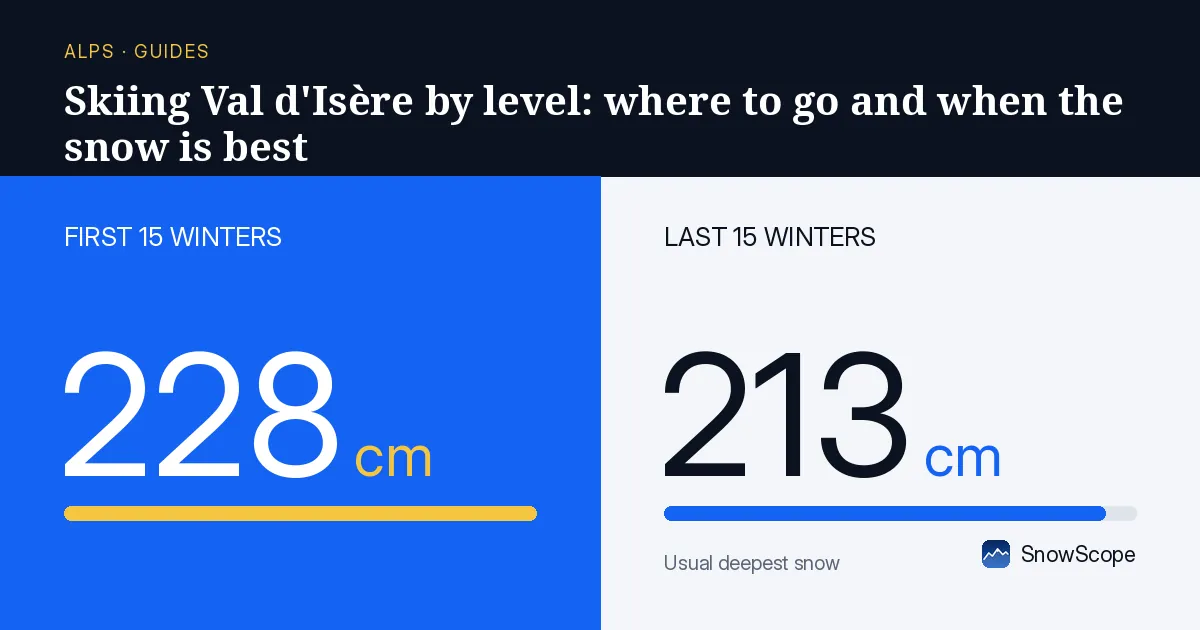
Who Val d'Isère suits
This is a resort for people who want a long season and a lot of height. Its racing pedigree is real: the Face de Bellevarde was the course of the men's downhill at the 1992 Olympic Games, and Jean-Claude Killy, who gave the Espace Killy its name, grew up in the village. Families and beginners are welcome too, but they will get the most from the upper slopes rather than the runs near the village. Together with Tignes the linked area has about 300 km of pistes, and the Grande Motte glacier above Tignes is skied in winter from the end of November to the beginning of May.
Beginners: stay high
Our snow history explains why. At 1,559 m, the lowest of our three heights, the deepest snow of a typical winter is about 117 cm, and there are at least 50 cm for only 10 weeks in 9 winters out of 10. At 2,503 m that figure rises to 21 weeks. In practice, learners get softer, more reliable snow on the gentle slopes higher up the mountain, and can ride a lift down at the end of the day when the lowest runs turn icy or thin.
Improvers: the middle of the mountain
Mid-mountain is where intermediates spend most of their days, and it holds snow well. At 2,503 m a typical winter has about 80 cm in December, 126 cm in January, 164 cm in February and 179 cm in March, with a peak of about 216 cm. The link to Tignes doubles the choice: when one side is windy or crowded, the other is often calmer.
Experts: steep faces and glaciers
Strong skiers come for the steep ground and the glaciers. The Pissaillas and Grande Motte glaciers both offer skiing, and they reach the high terrain where our model keeps the deepest snow: at 3,447 m, the top of our record, the peak of a typical winter is about 372 cm, usually reached in April. That depth hides crevasses and the off-piste slopes carry real avalanche risk, so go with a guide and read the Météo-France avalanche bulletin first.
When the snow is best
For mid-mountain the safest weeks run from late January to early April. In a typical winter the first snow of the season reaches 2,503 m around 5 October and the last melts around 19 June, which is why the upper area is often the first to have skiable snow. Early-December trips are a reasonable bet, but only for the high runs.
Like the rest of the Alps, the snow has thinned a little over time. In our first fifteen winters from 1980-81 the median peak at 2,503 m was about 228 cm; in the last fifteen, up to 2025-26, about 213 cm, with fewer days of snow on the ground (about 258 against 226). Last winter, 2025-26, was close to normal there, with a peak of about 222 cm.
Getting there and staying
The nearest major rail hub is Bourg-Saint-Maurice station, with onward road transfers up the valley; Lyon, Geneva and Chambéry are the usual airports. The village stretches along the valley floor, so a place to stay close to the main lifts saves walking in ski boots. Check lifts and opening dates on the resort's official website before you book.
Tips for skiers
- Beginners: book lessons on the upper beginner slopes and ride a lift down at the end of the day.
- Plan from late January to early April for the most reliable snow at mid-mountain.
- Glaciers and off-piste: hire a guide and read the Météo-France avalanche bulletin (BERA).
- Snow on our map does not mean a resort is open: check the lifts on the official website.
References and credits
- Wikipedia, 'Val-d'Isère', retrieved 7 November 2026. en.wikipedia.org/wiki/Val-d%27Is%C3%A8re
- Wikipedia, 'Tignes', retrieved 7 November 2026. en.wikipedia.org/wiki/Tignes
- Météo-France, mountain weather and avalanche risk bulletin (BERA) for the French massifs. meteofrance.com/meteo-montagne
About these numbers
Snow numbers: SnowScope snow history, 46 past winters (1980-81 to 2025-26) at three heights of the resort, a model of the past corrected for height (an estimate for an area, not resort reports). Lift, run and access facts: the sources listed below, checked on the date shown.
Official avalanche bulletins: Météo-France BERA
Cite this report
For research, teaching or the press: the numbers and charts are free to reuse under CC BY 4.0 with this citation.
SnowScope (2026), Skiing Val d'Isère by level: where to go and when the snow is best, https://snowscope.app/blog/en/2026/11/val-disere-skiing-by-level-espace-killy.html, accessed 2026-11-09
SnowScope (Atlas Labs). (2026, November 9). Skiing Val d'Isère by level: where to go and when the snow is best. SnowScope snow reports. https://snowscope.app/blog/en/2026/11/val-disere-skiing-by-level-espace-killy.html
BibTeX
@misc{snowscope2026valdisereskiingbyleveles,
  author       = {{SnowScope (Atlas Labs)}},
  title        = {Skiing Val d'Isère by level: where to go and when the snow is best},
  year         = {2026},
  month        = nov,
  howpublished = {\url{https://snowscope.app/blog/en/2026/11/val-disere-skiing-by-level-espace-killy.html}},
  note         = {Published 2026-11-09 20:53 UTC; accessed 2026-11-09}
}· CC BY 4.0 · Methods, data and tools →
Tignes - Val d'Isère: snow and temperature by height, this winter vs last (tools) →
Follow Tignes - Val d'Isère
Free: a message when fresh snow is coming, and the forecast every morning.

More snow reports
Cortina d'Ampezzo three ways: Tofana, Faloria-Cristallo and Cinque Torri-Lagazuoi, with 46 winters of snow data at three heights.
Our 46-winter Alps record at 108 points from 667 to 3,872 m: snow days down at all of them, clearly at 81 %. What changed at each height, and why.
Orcières Merlette leads the Alps forecast with 36 cm of new snow in the next three days, mostly on November 9–10, based on data from November 7.