 SnowScope
Zermatt snow facts: heights, snow-sure weeks and the glacier
Zermatt is a resort of extremes: the village sits at 1,620 m, while the Klein Matterhorn, the highest point of the lift network, reaches 3,883 m. That height gap explains almost everything about the snow here, so this guide starts with the numbers and then turns them into plans for the slopes.
See the live snow forecast for Zermatt - Breuil-Cervinia in the SnowScope appSnow depth, powder alerts and the 3D map, free.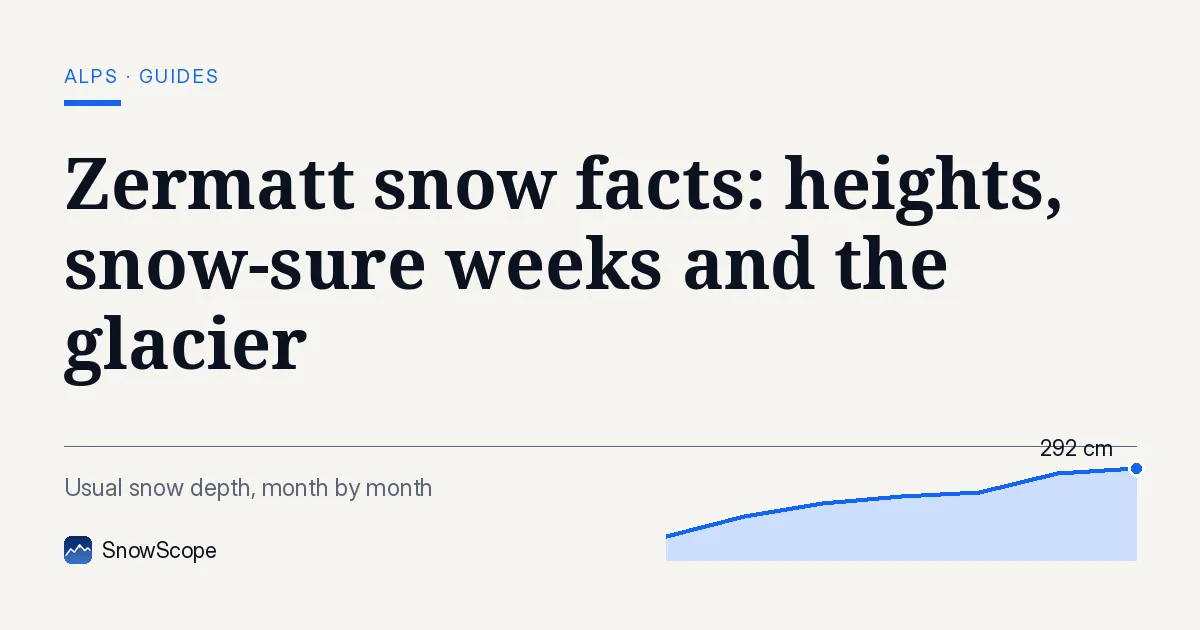
The fact file
Village: 1,620 m, closed to combustion-engine cars. Most visitors arrive on the rack-assisted train from Täsch, and trains also run from Visp and Brig further down the valley. Highest point: the Klein Matterhorn at 3,883 m. The ski area links with Cervinia and Valtournenche in Italy across the Plateau Rosa glacier, and the Theodul Glacier behind the Klein Matterhorn is used for summer skiing.
Our snow history covers 46 past winters (1980-81 to 2025-26) at three heights of the ski area: 1,559 m, 2,715 m and 3,872 m. These are model values for an area, corrected for height, not the resort's own snow reports.
What 46 winters say about each height
At 2,715 m, in the middle of the ski area, the deepest snow of a typical winter is about 143 cm. It builds slowly: about 54 cm in December, 79 cm in January, 94 cm in February and 102 cm in March, and it is usually deepest in April, with about 118 cm. In 9 winters out of 10 there are at least 50 cm at this height for 18 weeks of the season.
Low down the picture changes. At 1,559 m the peak of a typical winter is only about 35 cm, and no week of the season reliably reaches 50 cm. Near the top, at 3,872 m, the model peak is about 351 cm, with the deepest snow usually in May; part of the terrain up there is glacier, so read the top numbers as high-mountain snow, not as piste depth.
Snow-sure months
If you can choose, February to April is the safest window at mid-mountain. In a typical winter the first snow of the season reaches 2,715 m around 2 October and the last melts around 29 June, so early-season trips depend on the upper lifts. At 3,872 m the first snow usually comes around 24 September.
A slow change
Our record also shows a shift. In the first fifteen winters from 1980-81, the median peak at 2,715 m was about 156 cm; in the last fifteen, up to 2025-26, it was about 142 cm, and the days with snow on the ground fell from about 281 to 248. At the top the median peak went from about 394 cm to 342 cm. Last winter, 2025-26, the peak at mid-mountain was about 120 cm, below the long-term middle.
Using the numbers on the mountain
Beginners and early-season visitors: stay high, where the snow is deepest and the season longest, and ride a lift down rather than skiing the lowest runs on thin snow. Strong skiers: spring at altitude is the long game here, with the deepest snow of the year often arriving in April and May near the top. The glacier and the off-piste terrain around it are high-alpine ground, with crevasses as well as avalanches: go with a mountain guide.
Where to stay: the village is car-free and long, so a room near the station or near the lift you plan to use most saves a lot of walking with skis. Before any off-piste run, read the official avalanche bulletin of the Swiss institute WSL-SLF; for the Italian side, AINEVA lists the regional bulletins.
Tips for skiers
- For the most reliable snow, plan for February to April and ski the upper half of the area.
- Check lifts and opening dates on the resort's official website before you book: snow on our map does not mean a lift is running.
- Off-piste or on the glacier: read the WSL-SLF avalanche bulletin and hire a guide.
- Leave the car in Täsch: the village is reached by train.
References and credits
- Wikipedia, 'Zermatt', retrieved 7 November 2026. en.wikipedia.org/wiki/Zermatt
- WSL Institute for Snow and Avalanche Research SLF: avalanche bulletin and snow situation (Switzerland). www.slf.ch/en/avalanche-bulletin-and-snow-situation/
- AINEVA, the Italian inter-regional snow and avalanche association: links to the regional avalanche bulletins (Italian side). www.aineva.it/
About these numbers
Snow numbers: SnowScope snow history, 46 past winters (1980-81 to 2025-26) at three heights of the resort, a model of the past corrected for height (an estimate for an area, not resort reports). Lift, run and access facts: the sources listed below, checked on the date shown.
Official avalanche bulletins: WSL-SLF (Swiss side) / AINEVA (Italian side)
Cite this report
For research, teaching or the press: the numbers and charts are free to reuse under CC BY 4.0 with this citation.
SnowScope (2026), Zermatt snow facts: heights, snow-sure weeks and the glacier, https://snowscope.app/blog/en/2026/11/zermatt-snow-facts-heights-snow-sure-weeks.html, accessed 2026-11-10
SnowScope (Atlas Labs). (2026, November 10). Zermatt snow facts: heights, snow-sure weeks and the glacier. SnowScope snow reports. https://snowscope.app/blog/en/2026/11/zermatt-snow-facts-heights-snow-sure-weeks.html
BibTeX
@misc{snowscope2026zermattsnowfactsheightss,
  author       = {{SnowScope (Atlas Labs)}},
  title        = {Zermatt snow facts: heights, snow-sure weeks and the glacier},
  year         = {2026},
  month        = nov,
  howpublished = {\url{https://snowscope.app/blog/en/2026/11/zermatt-snow-facts-heights-snow-sure-weeks.html}},
  note         = {Published 2026-11-10 07:53 UTC; accessed 2026-11-10}
}· CC BY 4.0 · Methods, data and tools →
Zermatt - Breuil-Cervinia: snow and temperature by height, this winter vs last (tools) →
Follow Zermatt - Breuil-Cervinia
Free: a message when fresh snow is coming, and the forecast every morning.

More snow reports

A cheap 3-day Lake Como plan for December with real 2026-27 prices: trains, ferries, a funicular and a ski day at Piani di Bobbio or Madesimo, what you save compared with Cortina, and the chance of snow at Christmas.
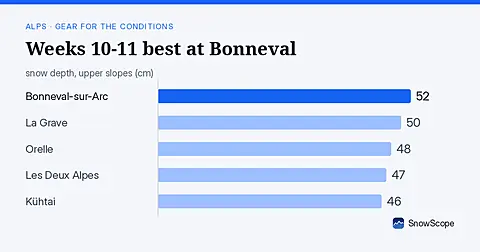
Bonneval-sur-Arc shows 52 cm upper slopes on 8 November. Weeks 10-11 are peak snow months. See what to pack for the forecast.
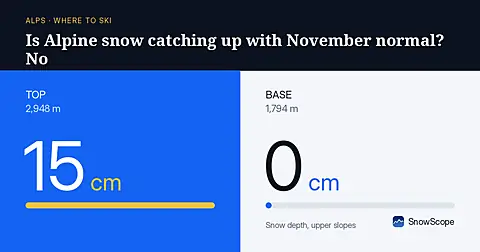
Alpine snow depths are running behind normal for early November, with only 55 cm at the best resorts as of November 3rd.