 SnowScope
Climate change and Alpine snow: fewer snow days at every height since 1980-81
The Alps still get big winters, but the snow season is shorter. In our 46-winter record at 36 resorts, every one of the 108 points, from 667 m to 3,872 m, lost snow days, and the loss is statistically clear at 81 % of them.
See the live snow forecast for Alps in the SnowScope appSnow depth, powder alerts and the 3D map, free.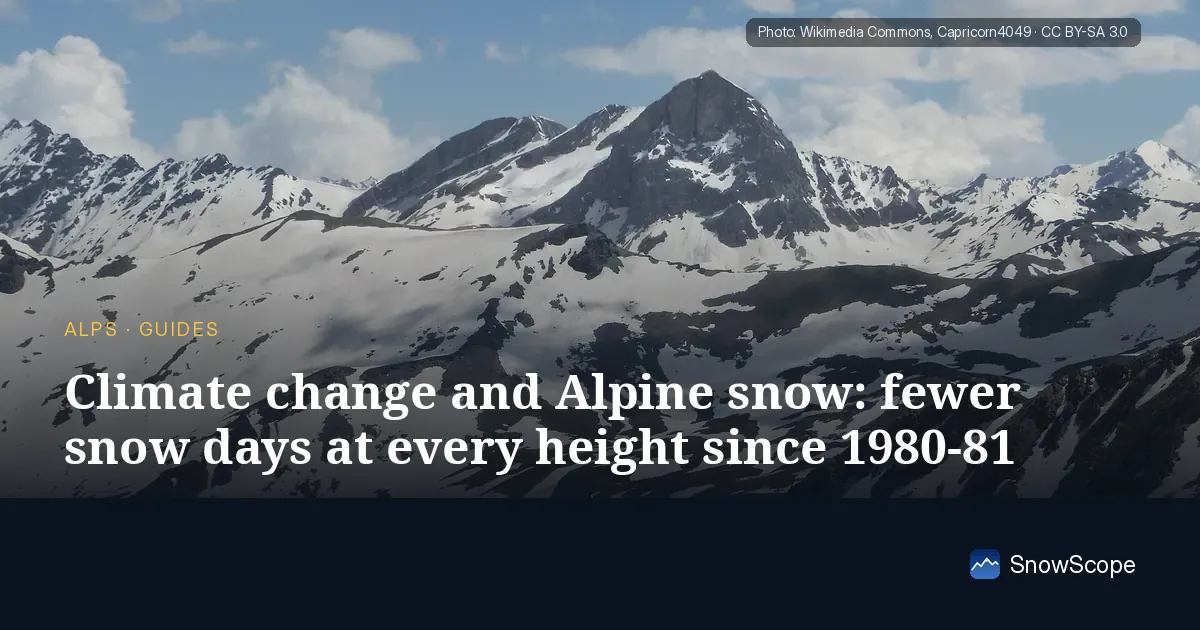
Below 1,500 m: the season shrinks first
Low slopes sit closest to the rain-snow limit. Here the middle point went from 174 snow days a winter (first 15 winters) to 153 (last 15), a drop of 12 %, and the deepest snow of the season from 52 cm to 44 cm, a drop of 16 %. The decline in snow days is clear at 77 % of these points, the drop in peak depth at 43 %: the clearest peak-depth signal of any height.
1,500 to 2,500 m: where most pistes are
Between 1,500 and 2,000 m snow days fell by 7 % (212 to 197) and the usual peak from 97 cm to 88 cm. Between 2,000 and 2,500 m they fell by 8 % (234 to 214), clearly at 90 % of the points, and the peak from 155 cm to 139 cm. The typical trend at these heights is a loss of about 6 to 7 snow days per decade.
Above 2,500 m: deep snow, but a shorter season
High up, a winter still brings well over two metres at the peak: the usual maximum went from 277 cm to 258 cm. The season itself shortened more: from 271 to 240 snow days, 11 %, and the decline is clear at 94 % of the high points. Snow arrives later in autumn and, above all, melts earlier in spring.
Recent winters in context
The poorest winter of our series is 2006-07, with a median of 158 snow days across the points; 2024-25 and 2025-26 follow with 174 each. The richest were 1980-81 (237), 2003-04 (236) and 1990-91 (234). Across all points the typical trend is a loss of about 7.0 snow days and 4.3 cm of peak depth per decade.
What measurements say
Station records tell the same story. Matiu and colleagues analysed snow depth at more than 800 stations in six Alpine countries from 1971 to 2019: on average, seasonal mean depth fell by 8.4 % per decade, seasonal maximum depth and snow cover duration by 5.6 % per decade, with the strongest trends where the snow-to-bare transition happens. In Switzerland, Marty found a step-like drop in snow days at the end of the 1980s at 34 stations between 200 and 1,800 m, a loss of 20 % to 60 %, linked to a jump in winter temperature. Klein and colleagues showed that the Swiss snow season has shortened since 1970 mainly because snow melts earlier in spring.
Our record starts in 1980-81, after part of that shift, and comes from a model rather than stations; that is why the two sets of numbers are not identical, but they point the same way.
What this means for a ski trip
The numbers do not say that the Alps are running out of snow. A typical high resort still has snow on the ground for most of the year, and big winters keep coming. What has changed is the margin: the early-season weeks before Christmas and the late weeks after Easter are less reliable than in the 1980s, and low resorts depend more on snowmaking and on the luck of each winter. Planning around height and slope orientation matters more than it used to.
Tips for skiers
- Before Christmas and after mid-April, pick high resorts and north-facing slopes.
- In low resorts, ski in the heart of winter and watch the live map.
- Check each resort's past-winters chart on SnowScope before you book.
- Off-piste, read the official avalanche bulletin of the country (EAWS lists them all).
References and credits
- Matiu, M., Crespi, A., Bertoldi, G., Carmagnola, C. M. et al. (2021). Observed snow depth trends in the European Alps: 1971 to 2019. The Cryosphere 15, 1343-1382. doi.org/10.5194/tc-15-1343-2021
- Marty, C. (2008). Regime shift of snow days in Switzerland. Geophysical Research Letters 35, L12501. doi.org/10.1029/2008GL033998
- Klein, G., Vitasse, Y., Rixen, C., Marty, C. and Rebetez, M. (2016). Shorter snow cover duration since 1970 in the Swiss Alps due to earlier snowmelt more than to later snow onset. Climatic Change 139, 637-649. doi.org/10.1007/s10584-016-1806-y
- Muñoz-Sabater, J. et al. (2021). ERA5-Land: a state-of-the-art global reanalysis dataset for land applications. Earth System Science Data 13, 4349-4383. doi.org/10.5194/essd-13-4349-2021
About these numbers
Our numbers: the SnowScope snow history, 46 past winters (1980-81 to 2025-26) read at the base, middle and top of each resort: ERA5-Land, a global reconstruction of past weather, corrected for height. It is a model of past winters, an estimate for an area, not station measurements. Snow day = at least 5 cm on the ground. Change = median of the last 15 winters against the first 15; trend = robust (Theil-Sen) line through all 46 winters, 'clear' when the Mann-Kendall test gives p < 0.05. Research findings: the sources below.
Cite this report
For research, teaching or the press: the numbers and charts are free to reuse under CC BY 4.0 with this citation.
SnowScope (2026), Climate change and Alpine snow: fewer snow days at every height since 1980-81, https://snowscope.app/blog/en/2026/11/alps-snow-days-climate-change-46-winters.html, accessed 2026-11-09
SnowScope (Atlas Labs). (2026, November 9). Climate change and Alpine snow: fewer snow days at every height since 1980-81. SnowScope snow reports. https://snowscope.app/blog/en/2026/11/alps-snow-days-climate-change-46-winters.html
BibTeX
@misc{snowscope2026alpssnowdaysclimatechang,
  author       = {{SnowScope (Atlas Labs)}},
  title        = {Climate change and Alpine snow: fewer snow days at every height since 1980-81},
  year         = {2026},
  month        = nov,
  howpublished = {\url{https://snowscope.app/blog/en/2026/11/alps-snow-days-climate-change-46-winters.html}},
  note         = {Published 2026-11-09 11:38 UTC; accessed 2026-11-09}
}· CC BY 4.0 · Methods, data and tools →
Follow Alps
Free: a message when fresh snow is coming, and the forecast every morning.

More snow reports
Seven days in the Silvretta Arena, one at a time: where the snow is, when to cross to Samnaun, and what 46 past winters say about Ischgl's snow at three heights.
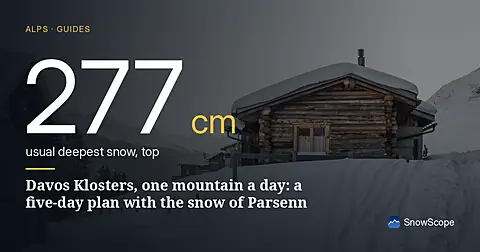
Davos and Klosters share six ski mountains. A day-by-day plan, starting on Parsenn, with what 46 past winters of our snow history say about its heights.
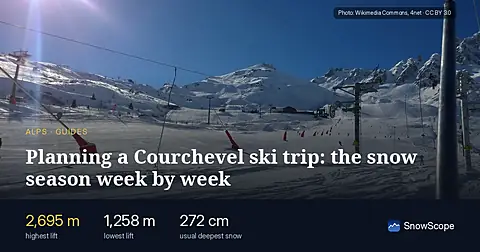
When to book Courchevel and the 3 Vallées, which village to stay in and where the snow lasts, planned from 46 past winters of snow data.