 SnowScope
Is climate change taking the Atlas snow? Oukaïmeden and 46 winters of data
Snow in the Moroccan Atlas comes and goes with a few storms, so a dry winter is not proof of climate change. Our 46-winter record does show one clear signal: above 2,500 m, at the height of Oukaïmeden, the season has become shorter.
See the live snow forecast for Oukaïmeden in the SnowScope appSnow depth, powder alerts and the 3D map, free.
What did we look at?
We read our snow history, a model of past winters corrected for height, at the base, middle and top of the three Atlas ski areas on our map: Oukaïmeden, Michlifen and Jbel Hebri, nine points from 1,870 m to 3,258 m, for the winters 1980-81 to 2025-26. A snow day is a day with at least 5 cm on the ground. These are estimates, not station measurements, and in a range this dry a model can be wrong by a lot at one place.
Is there less snow at Oukaïmeden?
At the three points above 2,500 m, the middle point had 145 snow days a winter in the first 15 winters and 128 in the last 15, a drop of 12 %. The trend is a loss of about 8.8 snow days per decade, and it passes the significance test at all three points. The deepest snow of the season also fell, from 102 cm to 92 cm, but that change is not statistically clear.
Why would the top show it first? Above 2,500 m the snow usually lasts for months, so a shorter season is easy to count. In the Atlas the sun is strong and the air is dry, and a little extra warmth in spring is enough to strip the slopes a few days earlier. Lower down, a snow cover rarely lasts long enough for such a change to be visible.
And lower down, near Ifrane?
Between 1,500 m and 2,500 m snow is rare: in a typical winter only a few weeks have 5 cm on the ground. Here our two measures disagree: the trend line points down, by about 1.7 snow days per decade, but the median of the last 15 winters is slightly higher than the first 15, and no point passes the significance test. Our honest answer is that the data cannot show a trend at these heights; a few big storms decide each winter.
How variable are Atlas winters?
Very. Across our nine points, the median number of snow days ranged from 4 in 2023-24 and 5 in 1999-00 to 100 in 2008-09. Two of the three poorest winters, 2023-24 and 2024-25, are recent, but 2025-26 was among the five snowiest, with 48.
What do scientists expect?
Research in the Atlas ties its snow to the big pressure patterns over the Atlantic, the North Atlantic Oscillation, and to the water supply of the plains: snowmelt feeds rivers and groundwater around Marrakech, as Hanich and colleagues summarise. For the Rheraya valley below Toubkal, Marchane and colleagues projected for 2049-2065 a warming of 1.4 to 2.6 °C and 22 % to 31 % less precipitation, with 19 % to 63 % less river flow, mainly because of less snow. At a larger scale, Tuel and Eltahir explain why the Mediterranean is a climate change hot spot, where up to 40 % of winter precipitation could be lost locally.
Tips for skiers
- Oukaïmeden is the only Atlas resort high enough for a regular season: watch the live map after each storm.
- Atlas snow can melt within days: go soon after a snowfall.
- Lower areas such as Michlifen need a cold storm: check the forecast snow line first.
- Off-piste and on Toubkal, ask local guides about conditions; Morocco has no public avalanche bulletin on our map.
References and credits
- Hanich, L., Chehbouni, A., Gascoin, S., Boudhar, A. et al. (2022). Snow hydrology in the Moroccan Atlas Mountains. Journal of Hydrology: Regional Studies 42, 101101. doi.org/10.1016/j.ejrh.2022.101101
- Marchane, A., Tramblay, Y., Hanich, L., Ruelland, D. and Jarlan, L. (2017). Climate change impacts on surface water resources in the Rheraya catchment (High Atlas, Morocco). Hydrological Sciences Journal 62, 979-995. doi.org/10.1080/02626667.2017.1283042
- Tuel, A. and Eltahir, E. A. B. (2020). Why is the Mediterranean a climate change hot spot? Journal of Climate 33, 5829-5843. doi.org/10.1175/JCLI-D-19-0910.1
- Muñoz-Sabater, J. et al. (2021). ERA5-Land: a state-of-the-art global reanalysis dataset for land applications. Earth System Science Data 13, 4349-4383. doi.org/10.5194/essd-13-4349-2021
About these numbers
Our numbers: the SnowScope snow history, 46 past winters (1980-81 to 2025-26) read at the base, middle and top of each resort: ERA5-Land, a global reconstruction of past weather, corrected for height. It is a model of past winters, an estimate for an area, not station measurements. Snow day = at least 5 cm on the ground. Change = median of the last 15 winters against the first 15; trend = robust (Theil-Sen) line through all 46 winters, 'clear' when the Mann-Kendall test gives p < 0.05. Research findings: the sources below.
Cite this report
For research, teaching or the press: the numbers and charts are free to reuse under CC BY 4.0 with this citation.
SnowScope (2026), Is climate change taking the Atlas snow? Oukaïmeden and 46 winters of data, https://snowscope.app/blog/en/2026/11/atlas-snow-climate-change-oukaimeden-46-winters.html, accessed 2026-11-09
SnowScope (Atlas Labs). (2026, November 9). Is climate change taking the Atlas snow? Oukaïmeden and 46 winters of data. SnowScope snow reports. https://snowscope.app/blog/en/2026/11/atlas-snow-climate-change-oukaimeden-46-winters.html
BibTeX
@misc{snowscope2026atlassnowclimatechangeou,
  author       = {{SnowScope (Atlas Labs)}},
  title        = {Is climate change taking the Atlas snow? Oukaïmeden and 46 winters of data},
  year         = {2026},
  month        = nov,
  howpublished = {\url{https://snowscope.app/blog/en/2026/11/atlas-snow-climate-change-oukaimeden-46-winters.html}},
  note         = {Published 2026-11-09 11:38 UTC; accessed 2026-11-09}
}· CC BY 4.0 · Methods, data and tools →
Oukaïmeden: snow and temperature by height, this winter vs last (tools) →
Follow Oukaïmeden
Free: a message when fresh snow is coming, and the forecast every morning.

More snow reports
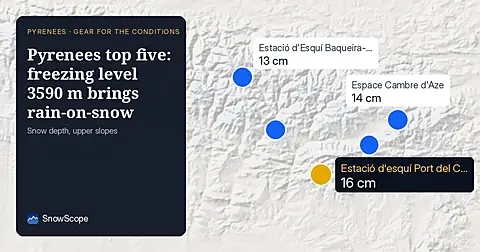
Freezing level reaches 3590 m across the Pyrenees on 9 November, bringing rain-on-snow to thin upper slopes. Pack waterproof layers and gaiters.
How much water the Atlas snow may hold in February 2027: the European seasonal forecast is about 3 °C warmer and wetter in the west and south, so snow odds stay low across Morocco's river basins.
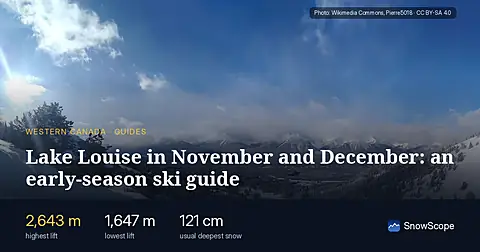
Skiing Lake Louise early in the season: why it starts early, what November and December snow usually looks like in 46 past winters, and how to ski thin early cover.