 SnowScope
A first ski day in Chamonix: Grands Montets, timing and snow
Chamonix, at 1,035 m below Mont Blanc, hosted the first Winter Olympic Games in 1924 and is still the place many skiers dream about. It is not one ski area but three: Les Grands Montets, Brévent-Flégère and Le Domaine de Balme. This is a first-day plan built around the Grands Montets, the area our snow record follows, from the first lift to the last run.
See the live snow forecast for Les Grands Montets in the SnowScope appSnow depth, powder alerts and the 3D map, free.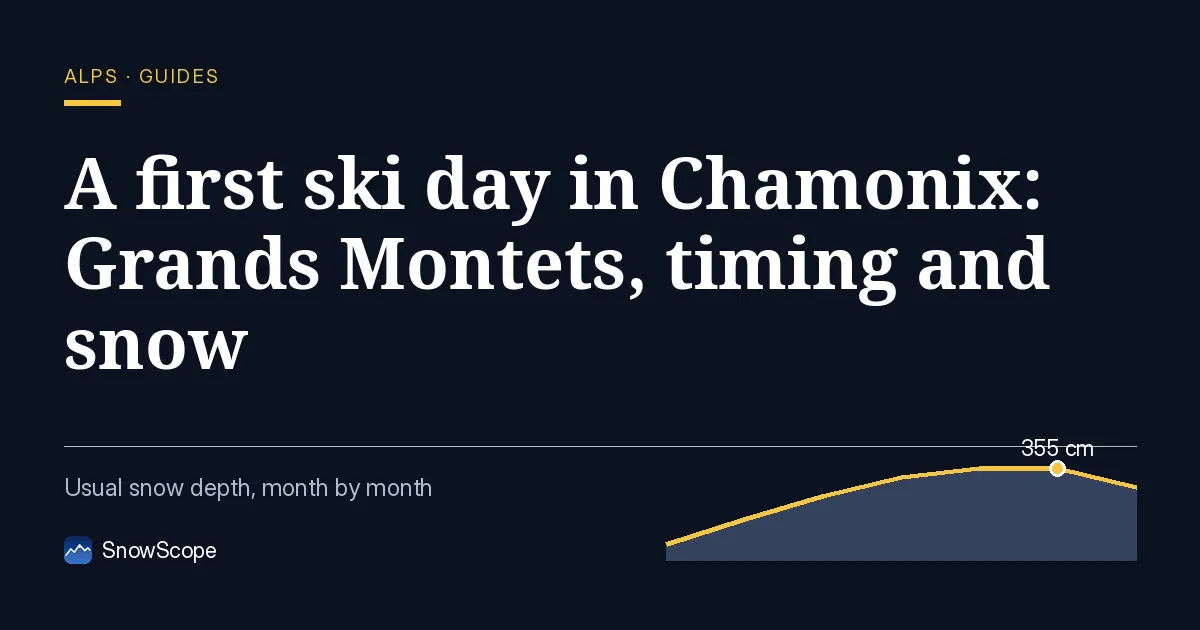
Before you go: what the snow is usually like
Our snow history covers 46 past winters (1980-81 to 2025-26) at three heights of the Grands Montets, as model values for an area corrected for height: 1,234 m near Argentière, 2,001 m mid-mountain and 2,768 m near the top of our record. At mid-mountain a typical winter has about 65 cm in December, 114 cm in January, 161 cm in February and 165 cm in March, with a peak of about 198 cm. At 2,768 m the typical peak is about 427 cm, and the snow is usually deepest in April, with about 355 cm.
In 9 winters out of 10 there are at least 50 cm at mid-mountain for 17 weeks of the season, and at the top for 26 weeks. The base is the weak point: at 1,234 m the same depth is reliable for only 8 weeks. So the best days in the village usually fall in February, when the base has about 101 cm in a typical winter.
8:30 - first lift: start high and cold
Take the first lifts up from Argentière and ski the upper slopes first, while the snow is still cold and smooth from the night. North-facing terrain like the upper Grands Montets keeps winter snow longest. Expert skiers who want the famous off-piste routes should have booked a guide the day before: this is glaciated, high-mountain terrain, and the avalanche bulletin decides what is reasonable that day.
11:00 - mid-mountain: the reliable middle
Late morning, drop to mid-mountain. This is where most of the Grands Montets' easier skiing is and where the snow is most dependable across the season. If the wind has closed the top, this is also where you will spend the day.
13:00 - lunch and a choice
After lunch, decide by the weather. On a clear day, a ride up the Aiguille du Midi cable car from Chamonix is worth it even without skiing: it climbs to 3,842 m, with the upper station at 3,777 m, in about 20 minutes. From there starts the Vallée Blanche, a 20 km long unmarked off-piste route over crevassed glacier, best done with a mountain guide; it is not a first-day run for anyone without one.
15:30 - last runs and the way down
In early and late winter the runs back to the valley can be thin, hard or patchy; in those weeks ride a lift down rather than ending the day on rocks. Over the years the snow has thinned a little: the median peak at mid-mountain was about 208 cm in our first fifteen winters and 196 cm in the last fifteen, with days of snow on the ground down from about 253 to 221. Last winter, 2025-26, was a good one there, with a peak of about 219 cm.
Getting there and staying
Geneva Airport is 88 km away. From Italy the Mont Blanc Tunnel, 11.6 km long and open since 1965, leads straight into the valley, and the Saint-Gervais - Vallorcine railway, opened in 1901, links the villages along it, including Argentière. To ski the Grands Montets first thing, stay in Argentière; to mix areas and evenings out, stay in Chamonix itself. Check lifts and opening dates on the official website before you go.
Tips for skiers
- Ski the high north-facing slopes in the morning, mid-mountain at midday, and ride down when the valley runs are thin.
- February is usually the best month for the whole mountain, base included.
- Off-piste, glacier and the Vallée Blanche: only with a mountain guide, after reading the Météo-France avalanche bulletin.
- Snow on our map does not mean a lift is running: check the official website.
References and credits
- Wikipedia, 'Chamonix', retrieved 7 November 2026. en.wikipedia.org/wiki/Chamonix
- Wikipedia, 'Aiguille du Midi', retrieved 7 November 2026. en.wikipedia.org/wiki/Aiguille_du_Midi
- Météo-France, mountain weather and avalanche risk bulletin (BERA) for the French massifs. meteofrance.com/meteo-montagne
About these numbers
Snow numbers: SnowScope snow history, 46 past winters (1980-81 to 2025-26) at three heights of the resort, a model of the past corrected for height (an estimate for an area, not resort reports). Lift, run and access facts: the sources listed below, checked on the date shown.
Official avalanche bulletins: Météo-France BERA
Cite this report
For research, teaching or the press: the numbers and charts are free to reuse under CC BY 4.0 with this citation.
SnowScope (2026), A first ski day in Chamonix: Grands Montets, timing and snow, https://snowscope.app/blog/en/2026/11/chamonix-first-ski-day-grands-montets.html, accessed 2026-11-09
SnowScope (Atlas Labs). (2026, November 9). A first ski day in Chamonix: Grands Montets, timing and snow. SnowScope snow reports. https://snowscope.app/blog/en/2026/11/chamonix-first-ski-day-grands-montets.html
BibTeX
@misc{snowscope2026chamonixfirstskidaygrand,
  author       = {{SnowScope (Atlas Labs)}},
  title        = {A first ski day in Chamonix: Grands Montets, timing and snow},
  year         = {2026},
  month        = nov,
  howpublished = {\url{https://snowscope.app/blog/en/2026/11/chamonix-first-ski-day-grands-montets.html}},
  note         = {Published 2026-11-09 11:38 UTC; accessed 2026-11-09}
}· CC BY 4.0 · Methods, data and tools →
Les Grands Montets: snow and temperature by height, this winter vs last (tools) →
Follow Les Grands Montets
Free: a message when fresh snow is coming, and the forecast every morning.

More snow reports

Saint François Longchamp sits at just 3 cm of snow, 12% of usual depth for this time, but 110 cm is forecast in the next two weeks.
Our 46-winter Alps record at 108 points from 667 to 3,872 m: snow days down at all of them, clearly at 81 %. What changed at each height, and why.
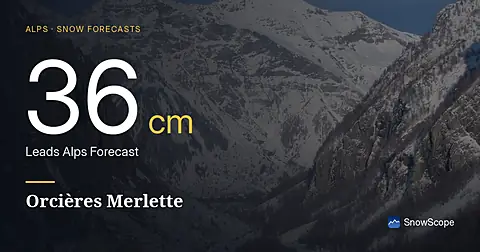
Orcières Merlette leads the Alps forecast with 36 cm of new snow in the next three days, mostly on November 9–10, based on data from November 7.