 SnowScope
Three ways to ski Cortina d'Ampezzo, and when the Dolomites snow is best
Cortina d'Ampezzo, a town at 1,224 m in the Dolomites, hosted the Winter Olympics in 1956 and again, with Milan, in 2026. Its ski terrain splits into three areas, and each suits a different skier. Here are three ways to spend your days, followed by what our snow history says about when to come.
See the live snow forecast for Cortina d'Ampezzo in the SnowScope appSnow depth, powder alerts and the 3D map, free.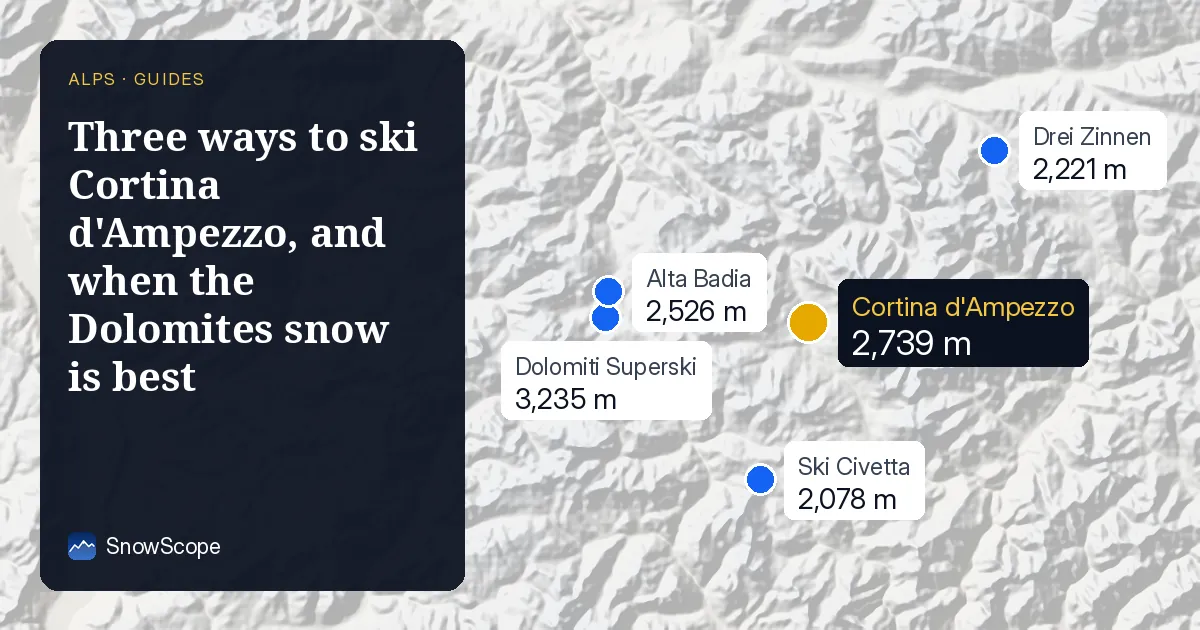
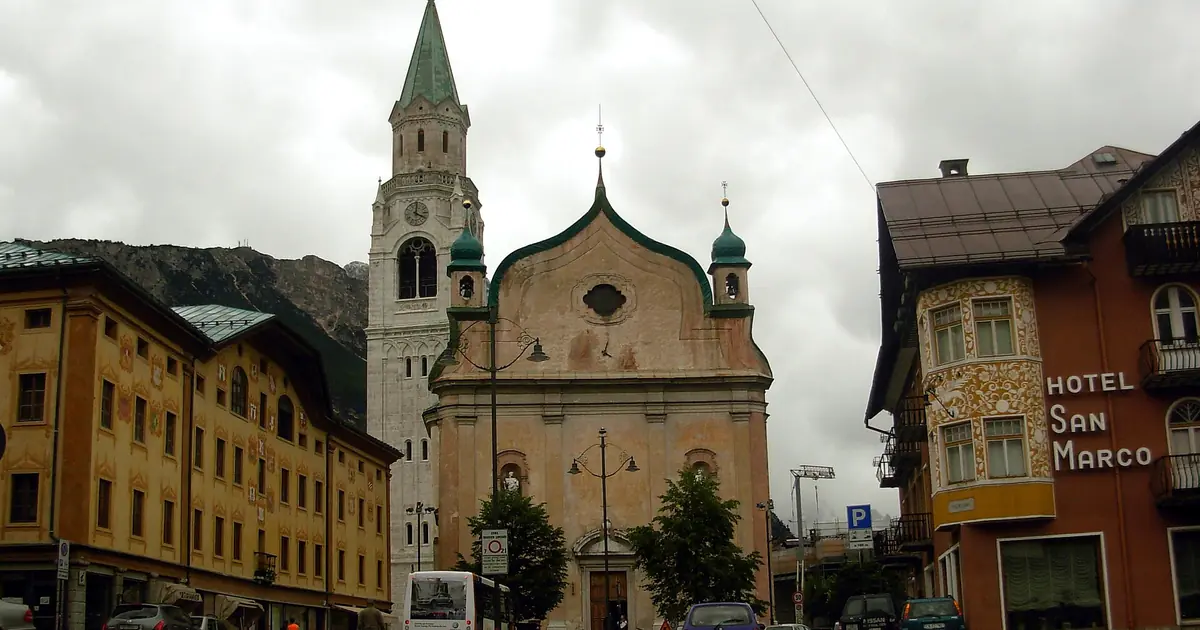
Way 1: the racer's mountain, Tofana
Tofana-Socrepes is the big, steep side of Cortina. Its Olympia delle Tofane run hosted the women's alpine events of the 2026 Olympics and the World Championships in 2021, and the Tofana Schuss is where racers pass 130 km/h. A cable car, the Freccia nel Cielo ('arrow in the sky'), climbs from Cortina almost to the top of Tofana di Mezzo, 3,244 m. Choose this side if you are a strong skier who wants long, fast descents.
Way 2: the relaxed middle, Faloria-Cristallo
Faloria-Cristallo is the second of Cortina's three areas, which together have 120 km of pistes and are linked by buses, lifts and pistes. It suits intermediates who want wide views and a relaxed pace. On any side of the valley, sunny slopes soften from late morning: ski them after the cold shaded runs, and early on mild spring days.
Way 3: the scenic tour, Cinque Torri-Lagazuoi
The third area, Cinque Torri-Lagazuoi, is the place for skiers who come as much for the landscape as for the runs. Lagazuoi is linked to the Sella Ronda ski area, with another 400 km of pistes, and Cortina as a whole is one of the 12 resorts of the Dolomiti Superski network. Plan a whole day for it and check the weather first: the high ground is exposed to wind.
When the snow is best
Our snow history covers 46 past winters (1980-81 to 2025-26) at three heights of the Cortina ski area, as model values for an area corrected for height: 859 m, the lowest point of the area we follow, 1,799 m and 2,739 m. Natural snow here is modest. At 1,799 m the deepest snow of a typical winter is about 75 cm, with about 30 cm in December, 47 cm in January, 53 cm in February and 55 cm in March; no week has at least 50 cm in 9 winters out of 10, and even the best week, in late March, reaches it in about 63 % of winters.
Higher up the picture is better: at 2,739 m a typical winter peaks at about 208 cm, with about 114 cm in February, 132 cm in March and 158 cm in April, and at least 50 cm for 16 weeks in 9 winters out of 10. So the most reliable natural snow is on the upper slopes from February to April. Down at 859 m a typical peak is only about 21 cm.
A dry run of winters
The upper slopes have lost more than most. At 2,739 m the median peak was about 226 cm in our first fifteen winters from 1980-81 and about 172 cm in the last fifteen, up to 2025-26. Last winter, 2025-26, was thin, with a peak of about 136 cm at the top and about 59 cm at mid-mountain. Expect the low runs to depend on machine-made snow, and check what is running on the official website before you book.
Getting there and safety
The nearest train station is Calalzo-Pieve di Cadore-Cortina, 35 km south. Venice Marco Polo airport is 148 km away and Treviso 138 km. Before skiing off-piste, read the avalanche bulletin for the Veneto Dolomites (AINEVA lists the regional bulletins, including Arabba), and remember that snow on our map does not mean a lift is running.
Tips for skiers
- Strong skiers: Tofana in the morning, before the crowds and while the snow is firm.
- For the best natural snow, aim for the upper slopes from February to April.
- Off-piste: read the regional avalanche bulletin (AINEVA, Veneto) and go with a guide.
- Travel: train to Calalzo, then bus; or fly to Venice or Treviso.
References and credits
- Wikipedia, 'Cortina d'Ampezzo', retrieved 7 November 2026. en.wikipedia.org/wiki/Cortina_d%27Ampezzo
- Wikipedia, 'Tofane', retrieved 7 November 2026. en.wikipedia.org/wiki/Tofane
- AINEVA, the Italian inter-regional snow and avalanche association: links to the regional avalanche bulletins, including Veneto (Arabba). www.aineva.it/
About these numbers
Snow numbers: SnowScope snow history, 46 past winters (1980-81 to 2025-26) at three heights of the resort, a model of the past corrected for height (an estimate for an area, not resort reports). Lift, run and access facts: the sources listed below, checked on the date shown.
Official avalanche bulletins: AINEVA
Cite this report
For research, teaching or the press: the numbers and charts are free to reuse under CC BY 4.0 with this citation.
SnowScope (2026), Three ways to ski Cortina d'Ampezzo, and when the Dolomites snow is best, https://snowscope.app/blog/en/2026/11/cortina-d-ampezzo-three-ways-to-ski-dolomites-snow.html, accessed 2026-11-09
SnowScope (Atlas Labs). (2026, November 9). Three ways to ski Cortina d'Ampezzo, and when the Dolomites snow is best. SnowScope snow reports. https://snowscope.app/blog/en/2026/11/cortina-d-ampezzo-three-ways-to-ski-dolomites-snow.html
BibTeX
@misc{snowscope2026cortinadampezzothreeways,
  author       = {{SnowScope (Atlas Labs)}},
  title        = {Three ways to ski Cortina d'Ampezzo, and when the Dolomites snow is best},
  year         = {2026},
  month        = nov,
  howpublished = {\url{https://snowscope.app/blog/en/2026/11/cortina-d-ampezzo-three-ways-to-ski-dolomites-snow.html}},
  note         = {Published 2026-11-09 11:38 UTC; accessed 2026-11-09}
}· CC BY 4.0 · Methods, data and tools →
Cortina d'Ampezzo: snow and temperature by height, this winter vs last (tools) →
Follow Cortina d'Ampezzo
Free: a message when fresh snow is coming, and the forecast every morning.

More snow reports
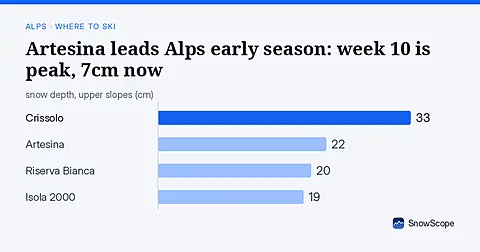
Artesina holds the deepest snow in the Alps this weekend with 22 cm upper slopes. Week 10 sees the best conditions historically. Data from 5 November.
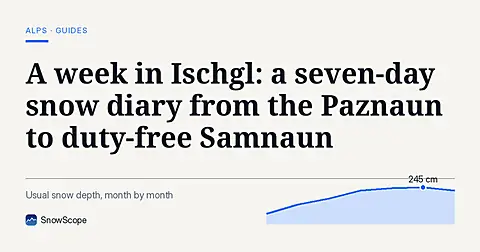
Seven days in the Silvretta Arena, one at a time: where the snow is, when to cross to Samnaun, and what 46 past winters say about Ischgl's snow at three heights.
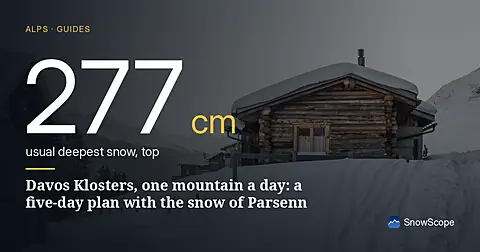
Davos and Klosters share six ski mountains. A day-by-day plan, starting on Parsenn, with what 46 past winters of our snow history say about its heights.