 SnowScope
Davos Klosters, one mountain a day: a five-day plan with the snow of Parsenn
Davos is a town of 1,560 m that most people know from the news: since 1971 it has hosted the World Economic Forum. Skiers know it for something else. Together with Klosters, about 10 km away, it has six separate ski mountains with about 320 km of slopes. The best way to see them is one at a time. Here is a five-day plan, built around Parsenn, where our snow numbers come from.
See the live snow forecast for Parsenn in the SnowScope appSnow depth, powder alerts and the 3D map, free.
Day 1: Parsenn from Davos Dorf
Start where the snow is most reliable. The Parsennbahn funicular leaves Davos Dorf for the Weissfluhjoch, and from the top the runs spread out towards Davos and Klosters. In our model of 46 past winters, the top of our Parsenn record, at 2,811 m, has a usual peak of about 277 cm, and there are at least 50 cm for 24 weeks in 9 winters out of 10. Spend the first day up here, learn the layout, and take a lift down if the lower runs look thin.
Day 2: over to Klosters by Gotschna
Parsenn links to the Gotschna side above Klosters, a village at 1,205 m. The Gotschnagrat cable car, renamed King Charles in 2023, climbs to 2,281 m. Klosters is known for terrain that suits intermediate to advanced skiers. The descent to the village is the part to watch: our lowest point, at 1,000 m, has a usual peak of only about 41 cm, and in no week does it hold 50 cm in 9 winters out of 10. In a mild spell, plan to ride down.
Day 3: Jakobshorn
Jakobshorn is a separate area from Parsenn, so start the day there rather than trying to combine it with Parsenn. Our numbers cover Parsenn, not Jakobshorn, but the logic of height is the same on every mountain here: the higher you ski, the longer the snow lasts.
Day 4: Rinerhorn or Pischa
These two Davos mountains are good choices when Parsenn is busy, or on a stormy day when you want a short, simple day. Check which lifts are running before you go; any lift can close in strong wind.
Day 5: Madrisa above Klosters
Finish on Madrisa, the second ski mountain of Klosters, so the week ends in the village where Day 2 began.
When to come, and the long view
At mid-mountain on Parsenn, 1,905 m in our record, a typical winter has about 49 cm of snow in December, 77 cm in January, 109 cm in February, 116 cm in March and 105 cm in April. There are at least 50 cm for 15 weeks in 9 winters out of 10, so February and March are the safest weeks. Near the top, April is the deepest month, with about 224 cm, and May still has about 203 cm.
The middle of the mountain has lost snow over the years. In our first fifteen winters from 1980-81 the median peak at 1,905 m was about 148 cm; in the last fifteen, about 128 cm, with fewer days of snow on the ground, about 251 against 221. Near the top the median peak has barely changed, about 279 against 276 cm. Last winter, 2025-26, was thin: about 109 cm at mid-mountain and 196 cm near the top.
A good place to read the snow
Davos is home to the WSL Institute for Snow and Avalanche Research SLF, which publishes the Swiss avalanche bulletin. Read it before any off-piste run, and check the lifts on the official website before you travel.
Tips for skiers
- Start the week on Parsenn, the highest and most snow-sure mountain in our record.
- On the Klosters side, ride down when the lower runs look thin.
- Keep Rinerhorn or Pischa for busy or stormy days.
- Read the SLF avalanche bulletin before off-piste; snow on our map does not mean lifts are open.
References and credits
- Wikipedia, 'Davos', retrieved 8 November 2026: altitude, ski areas, Parsennbahn, World Economic Forum, SLF. en.wikipedia.org/wiki/Davos
- Wikipedia, 'Klosters', retrieved 8 November 2026: altitude, distance to Davos, Gotschna cable car. en.wikipedia.org/wiki/Klosters
- WSL Institute for Snow and Avalanche Research SLF, avalanche bulletin and snow situation for Switzerland. www.slf.ch/en/avalanche-bulletin-and-snow-situation/
About these numbers
Snow numbers: SnowScope snow history, 46 past winters (1980-81 to 2025-26) at three heights of the resort, a model of the past corrected for height (an estimate for an area, not resort reports). Lift, run and access facts: the sources listed below, checked on the date shown.
Official avalanche bulletins: WSL-SLF
Cite this report
For research, teaching or the press: the numbers and charts are free to reuse under CC BY 4.0 with this citation.
SnowScope (2026), Davos Klosters, one mountain a day: a five-day plan with the snow of Parsenn, https://snowscope.app/blog/en/2026/11/davos-klosters-one-mountain-a-day-parsenn-snow.html, accessed 2026-11-09
SnowScope (Atlas Labs). (2026, November 9). Davos Klosters, one mountain a day: a five-day plan with the snow of Parsenn. SnowScope snow reports. https://snowscope.app/blog/en/2026/11/davos-klosters-one-mountain-a-day-parsenn-snow.html
BibTeX
@misc{snowscope2026davosklostersonemountain,
  author       = {{SnowScope (Atlas Labs)}},
  title        = {Davos Klosters, one mountain a day: a five-day plan with the snow of Parsenn},
  year         = {2026},
  month        = nov,
  howpublished = {\url{https://snowscope.app/blog/en/2026/11/davos-klosters-one-mountain-a-day-parsenn-snow.html}},
  note         = {Published 2026-11-09 11:16 UTC; accessed 2026-11-09}
}· CC BY 4.0 · Methods, data and tools →
Parsenn: snow and temperature by height, this winter vs last (tools) →
Follow Parsenn
Free: a message when fresh snow is coming, and the forecast every morning.

More snow reports
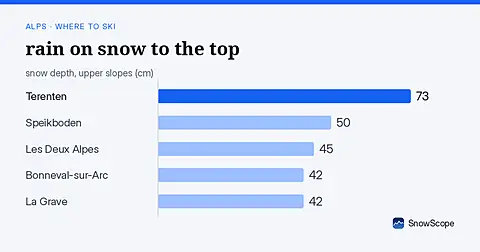
Terenten has 73 cm on upper slopes as of 4 November; freezing level will reach 2970 m on 5 November, bringing rain to the summit at 1381 m.
In 24 of 46 winters, resorts on the Italian and southern French side of the Alps had a relatively bigger winter than the northern side. The chart, the big years and the weather behind them.
A year of snow in Sölden, phase by phase: when the glaciers whiten, the World Cup weekend, the long middle of winter and the spring weeks, from 46 past winters at three heights.