 SnowScope
Jackson Hole ski myths and facts: snow, steeps and the tram
Jackson Hole Mountain Resort has a reputation that arrives before you do: steep, wild, experts only. Some of it is true, some of it is not. Here are six common beliefs, checked against the published facts of the resort and our snow history of 46 past winters (a model, not resort reports).
See the live snow forecast for Jackson Hole Mountain Resort in the SnowScope appSnow depth, powder alerts and the 3D map, free.
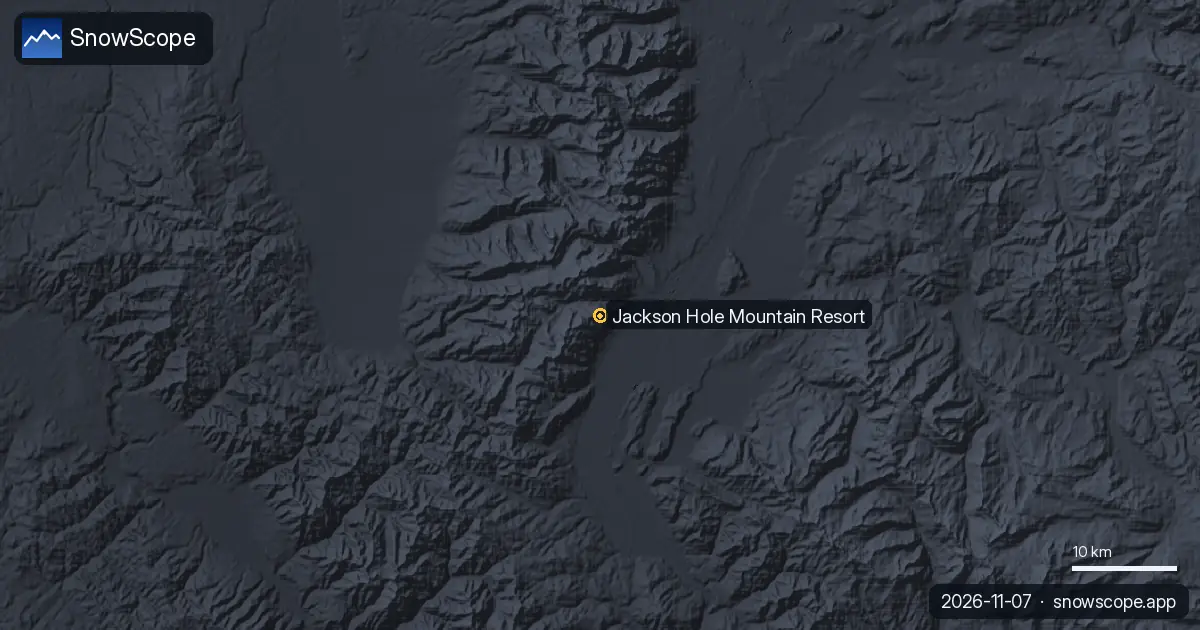
Myth: it is only for experts
Fact: the steep terrain is real, and it is the reason many people come, but it is not the whole mountain. The resort has 2,500 acres inbounds over a vertical drop of 4,139 ft (1,262 m), from a base at 6,311 ft (1,924 m) to the top of Rendezvous Mountain at 10,450 ft (3,185 m). The lower mountain has gentler slopes where beginners and cautious intermediates can spend good days. The honest advice: intermediates will enjoy it, but should not expect a mountain of easy cruising runs.
Myth: you ski straight from the town of Jackson
Fact: the resort is in Teton Village, about twelve miles northwest of Jackson, and Jackson Hole Airport is about 11 miles northeast of Teton Village. Staying in Teton Village puts you at the lifts; staying in Jackson gives more choice of beds and restaurants, with a drive or bus each morning.
Myth: the snow is gone by spring
Fact: in our model the high mountain keeps its snow late. Near the top, around 10,397 ft (3,169 m), April is the deepest month of a usual winter, about 105 in (267 cm), and the usual peak of the season is about 117 in (297 cm). At mid-mountain, around 8,363 ft (2,549 m), the usual depth is about 36 in (92 cm) in December, 54 in (136 cm) in January, 65 in (165 cm) in February, 71 in (180 cm) in March and still 67 in (169 cm) in April. The lower slopes near 6,329 ft (1,929 m) are the exception: they peak at only about 46 in (116 cm) and melt first.
Myth: climate change has already emptied the mountain
Fact: not at mid-mountain, according to our model. Comparing the first 15 winters of the record with the last 15, the usual peak there is about the same, about 80 in (203 cm) then and 81 in (205 cm) now, although the number of days with snow on the ground fell from 250 to 239. Near the top the peak is slightly lower, about 112 in (285 cm) against 117 in (297 cm). Last winter, 2025-26, peaked at about 64 in (162 cm) at mid-mountain, below the usual. In 9 of 10 winters, mid-mountain had at least 20 in (50 cm) for 22 weeks of the season.
Myth: Corbet's Couloir is the reason to go
Fact: Corbet's Couloir is the resort's most famous and most difficult line, and most visitors only look at it. The better reason to go is the wide range of terrain that holds snow after storms, and the aerial tram, a 100-passenger cabin that opened on 20 December 2008 and replaced the original tram of 1966, which takes you to the top in one ride.
Myth: the backcountry gate means it is safe
Fact: the resort lists about 3,000 acres of backcountry beyond its boundary, and leaving through a gate means leaving patrolled terrain. Read the daily Bridger-Teton Avalanche Center forecast, carry a transceiver, probe and shovel, and go with partners who know the terrain.
Tips for skiers
- Intermediates: come, but plan your days around the gentler lower and middle mountain.
- For the deepest snow, aim for February to April; the high mountain holds it longest.
- Stay in Teton Village to walk to the lifts, or in Jackson for more choice.
- Never pass a backcountry gate without the avalanche forecast and rescue gear.
References and credits
- Wikipedia, 'Jackson Hole Mountain Resort' (retrieved 7 November 2026): elevations, vertical drop, inbounds and backcountry acres, aerial tram of 2008, Corbet's Couloir, Teton Village, Jackson Hole Airport. en.wikipedia.org/wiki/Jackson_Hole_Mountain_Resort
- Jackson Hole Mountain Resort, official website. www.jacksonhole.com/
- Bridger-Teton Avalanche Center, official avalanche forecasts for the Teton area. bridgertetonavalanchecenter.org/
About these numbers
Snow numbers: SnowScope snow history, 46 past winters (1980-81 to 2025-26) at three heights of the resort, a model of the past corrected for height (an estimate for an area, not resort reports). Lift, run and access facts: the sources listed below, checked on the date shown.
Official avalanche bulletins: Bridger-Teton Avalanche Center
Cite this report
For research, teaching or the press: the numbers and charts are free to reuse under CC BY 4.0 with this citation.
SnowScope (2026), Jackson Hole ski myths and facts: snow, steeps and the tram, https://snowscope.app/blog/en/2026/11/jackson-hole-ski-myths-and-facts.html, accessed 2026-11-09
SnowScope (Atlas Labs). (2026, November 9). Jackson Hole ski myths and facts: snow, steeps and the tram. SnowScope snow reports. https://snowscope.app/blog/en/2026/11/jackson-hole-ski-myths-and-facts.html
BibTeX
@misc{snowscope2026jacksonholeskimythsandfa,
  author       = {{SnowScope (Atlas Labs)}},
  title        = {Jackson Hole ski myths and facts: snow, steeps and the tram},
  year         = {2026},
  month        = nov,
  howpublished = {\url{https://snowscope.app/blog/en/2026/11/jackson-hole-ski-myths-and-facts.html}},
  note         = {Published 2026-11-09 20:02 UTC; accessed 2026-11-09}
}· CC BY 4.0 · Methods, data and tools →
Jackson Hole Mountain Resort: snow and temperature by height, this winter vs last (tools) →
Follow Jackson Hole Mountain Resort
Free: a message when fresh snow is coming, and the forecast every morning.

More snow reports
What the measured snow gauges say about the North Lake Tahoe storm, why the first snow is heavy and wet, and how Sugar Bowl, Northstar and Diamond Peak compare with 46 winters.
About 28 inches of new snow at Mammoth and 26 inches at June Mountain on 18-19 November. What the storm is, how it ranks against past winters, and the best days to go.
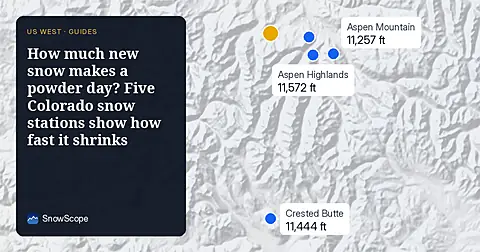
A storm on November 4 left 8 to 13 inches of new snow at five high Colorado stations near Aspen. Five days later, half of it was gone. What that means for powder days.