 SnowScope
Les Arcs village by village: which Arc to stay in, and where the snow lasts
Les Arcs is not one resort but a family of purpose-built villages on the same mountain above Bourg-Saint-Maurice, each named after its rough altitude. Choosing the right one matters more than most people think: it decides how far you walk to the snow, how you arrive and which slopes you see first every morning.
See the live snow forecast for Les Arcs in the SnowScope appSnow depth, powder alerts and the 3D map, free.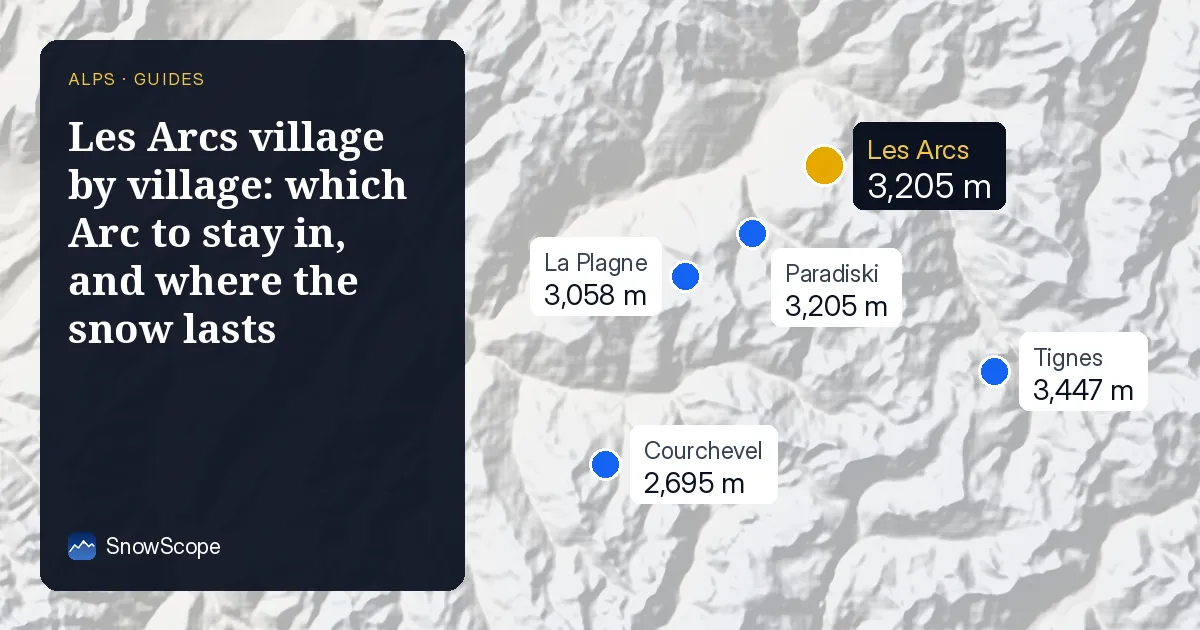
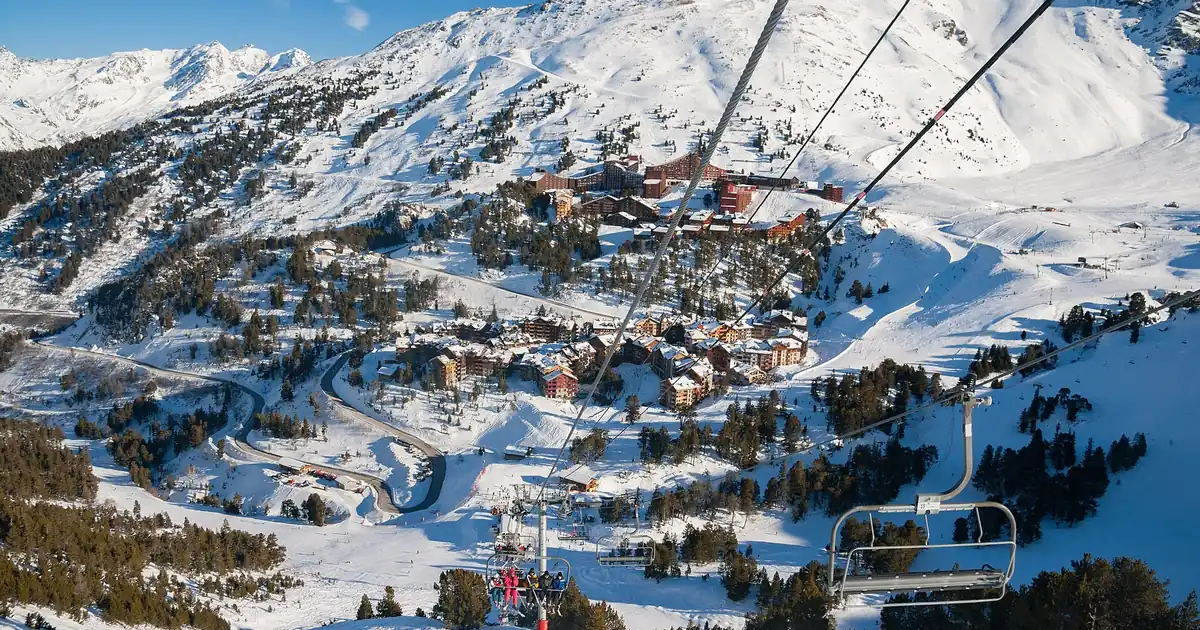
Arc 1600: the train-to-snow village
The oldest village opened in 1968, and it is still the easiest to reach without a car: the Arc en Ciel funicular, installed in 1986, climbs from Bourg-Saint-Maurice station in about 7 minutes. For families who want the shortest possible transfer, that alone can decide the choice.
Arc 1800: the middle way
Arc 1800 opened in 1974, the second of the villages, and suits groups who want the middle of the mountain at their door. Its height puts it between our lowest and middle points, so its snow is usually reliable from mid-winter, but the runs back down to the village are the first to suffer after a mild spell.
Arc 1950 and Arc 2000: closest to the high snow
Arc 2000 opened in 1979 and Arc 1950, a village of residences, was completed in 2008. They stand close to our middle point at 2,213 m, where a typical winter, in our model of 46 past winters, has about 68 cm of snow in December, 115 cm in January, 150 cm in February and 160 cm in March, with a usual peak of about 191 cm. At that height there are at least 50 cm for 21 weeks in 9 winters out of 10, against only 2 weeks at our lowest point, 1,222 m.
These villages also give the quickest access to the Aiguille Rouge, the highest summit of the area at 3,250 m, and to the speed skiing course that was used at the 1992 Olympic Games. Near the top of our record, at 3,205 m, the usual peak is about 379 cm and April is the deepest month, with about 315 cm.
Paradiski: when one mountain is not enough
Since December 2003 the Vanoise Express has linked Les Arcs to Peisey-Vallandry and La Plagne. Together they form Paradiski, with about 425 km of pistes and 160 lifts. For a week-long stay a Paradiski pass for one or two days is often enough; the crossing is the highlight, and it is worth checking the wind before you go, because high-altitude links can close.
How the snow has changed
Our record shows less snow at mid-mountain than in the past. In the first fifteen winters from 1980-81 the median peak at 2,213 m was about 212 cm; in the last fifteen, to 2025-26, it was about 182 cm, and the days with snow on the ground fell from about 256 to 226. Last winter was a good one there, with a peak of about 212 cm. The lesson is simple: the higher villages give more margin in a thin year.
Which Arc for you?
Pick Arc 1600 if you come by train and like quiet evenings, Arc 1800 to be in the middle of things, and Arc 1950 or Arc 2000 if snow reliability and steep ground matter most. Whichever you choose, check lift openings on the official website before you book and read the Météo-France avalanche bulletin before any off-piste day.
Tips for skiers
- Arriving by train: the funicular to Arc 1600 saves a road transfer.
- For the surest snow, stay in Arc 1950 or Arc 2000, close to our mid-mountain point.
- Plan a Paradiski day on a calm, clear day; high links can close in strong wind.
- Snow on our map does not mean a resort is open: check lifts on the official website.
References and credits
- Wikipedia, 'Les Arcs', retrieved 8 November 2026: villages and opening years, Arc en Ciel funicular, Aiguille Rouge, speed skiing course. en.wikipedia.org/wiki/Les_Arcs
- Wikipedia, 'Paradiski', retrieved 8 November 2026: linked area, pistes and lifts, Vanoise Express. en.wikipedia.org/wiki/Paradiski
- Météo-France, mountain weather and avalanche risk bulletins (BERA) for the French massifs. meteofrance.com/meteo-montagne
About these numbers
Snow numbers: SnowScope snow history, 46 past winters (1980-81 to 2025-26) at three heights of the resort, a model of the past corrected for height (an estimate for an area, not resort reports). Lift, run and access facts: the sources listed below, checked on the date shown.
Official avalanche bulletins: Météo-France BERA
Cite this report
For research, teaching or the press: the numbers and charts are free to reuse under CC BY 4.0 with this citation.
SnowScope (2026), Les Arcs village by village: which Arc to stay in, and where the snow lasts, https://snowscope.app/blog/en/2026/11/les-arcs-village-by-village-snow-paradiski.html, accessed 2026-11-09
SnowScope (Atlas Labs). (2026, November 9). Les Arcs village by village: which Arc to stay in, and where the snow lasts. SnowScope snow reports. https://snowscope.app/blog/en/2026/11/les-arcs-village-by-village-snow-paradiski.html
BibTeX
@misc{snowscope2026lesarcsvillagebyvillages,
  author       = {{SnowScope (Atlas Labs)}},
  title        = {Les Arcs village by village: which Arc to stay in, and where the snow lasts},
  year         = {2026},
  month        = nov,
  howpublished = {\url{https://snowscope.app/blog/en/2026/11/les-arcs-village-by-village-snow-paradiski.html}},
  note         = {Published 2026-11-09 18:59 UTC; accessed 2026-11-09}
}· CC BY 4.0 · Methods, data and tools →
Les Arcs: snow and temperature by height, this winter vs last (tools) →
Follow Les Arcs
Free: a message when fresh snow is coming, and the forecast every morning.

More snow reports
Seven days in the Silvretta Arena, one at a time: where the snow is, when to cross to Samnaun, and what 46 past winters say about Ischgl's snow at three heights.
Davos and Klosters share six ski mountains. A day-by-day plan, starting on Parsenn, with what 46 past winters of our snow history say about its heights.
When to book Courchevel and the 3 Vallées, which village to stay in and where the snow lasts, planned from 46 past winters of snow data.