 SnowScope
Planning a Courchevel ski trip: the snow season week by week
Courchevel is not one village but four, named after their heights: Courchevel 1300 (Le Praz), 1550, 1650 (Moriond) and 1850. All of them sit in Les Trois Vallées, which has 600 km of slopes and 183 lifts. This planner uses our snow history to answer the questions that decide a trip: when to go, where to stay and which slopes to ski at each point of the winter.
See the live snow forecast for Courchevel in the SnowScope appSnow depth, powder alerts and the 3D map, free.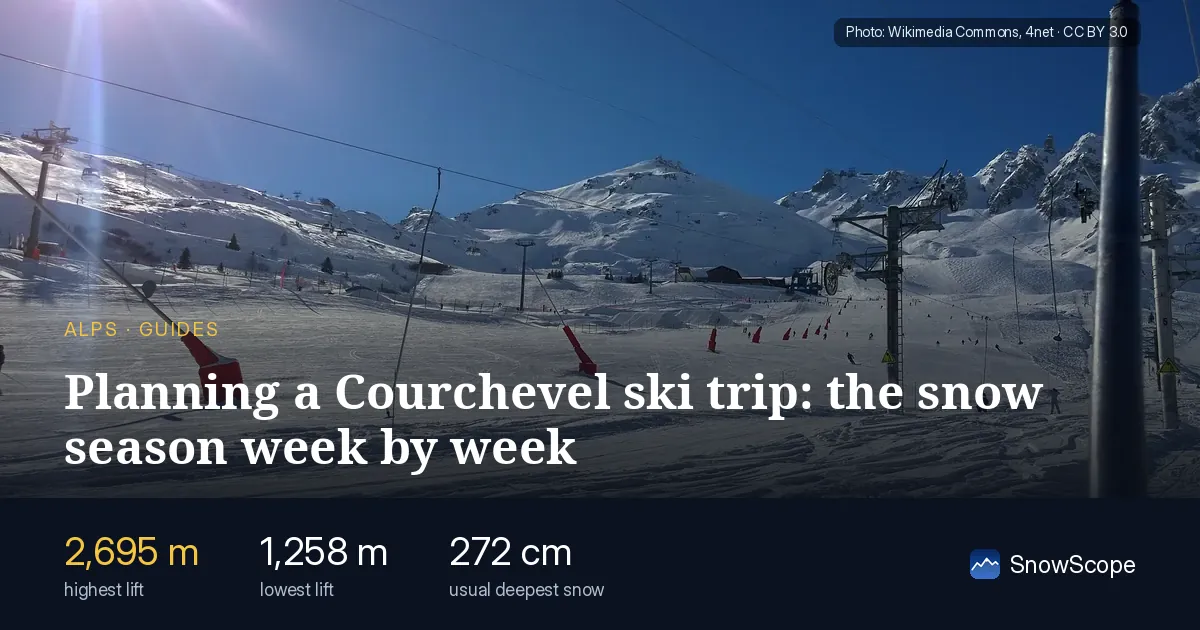
Step 1: choose your weeks
Our snow history covers 46 past winters (1980-81 to 2025-26), as model values for an area corrected for height, at three heights: 1,258 m, 1,976 m and 2,695 m. At 1,976 m, the heart of the ski area, a typical winter has about 54 cm in December, 94 cm in January, 125 cm in February, 132 cm in March and still 121 cm in April. In 9 winters out of 10 there are at least 50 cm at that height for 18 weeks, and the week with the best record, in early March, had that depth in every winter of our record.
So: the safest weeks run from late January to the end of March. Early December is a fair bet only for the upper slopes, and April is often excellent up high but thin low down: by May mid-mountain is down to about 61 cm in a typical winter.
Step 2: choose your village
Height matters for the walk back to your bed. Near the bottom of our record, at 1,258 m, a typical winter peaks at only about 71 cm, with about 59 cm in February and 54 cm in March; no week has 50 cm in 9 winters out of 10. The higher villages are the safe choice for skiing back to the door late in the season, while Le Praz suits people who are happy to ride a lift down when the lowest runs are thin.
Step 3: plan your days on the mountain
Near the top, at 2,695 m, the usual depth is about 162 cm in January, 202 cm in February, 220 cm in March and 232 cm in April, the deepest month. Ski the high, north-facing slopes when the snow is cold and dry, and move to sunny slopes from late morning in spring, once they have softened. The whole 3 Vallées is linked on one pass, as it has been since 1971, so on a crowded day it is worth heading towards Méribel or beyond; the highest point of the linked area is 3,230 m, in Val Thorens.
Step 4: allow for a weaker winter
Plans should leave room for a lean season. At mid-mountain the deepest snow of a typical winter is about 158 cm, but our record ranges from about 118 cm in the thinnest winter to about 227 cm in the snowiest. Over time the snow has thinned: the median peak at 1,976 m was about 171 cm in our first fifteen winters and about 152 cm in the last fifteen, and the days with snow on the ground fell from about 241 to 217. Last winter, 2025-26, was better than usual, with a peak of about 173 cm.
Step 5: travel and safety
The rail gateway is Moûtiers-Salins-Brides-les-Bains station, with direct TGV services from Paris in around 5 hours 30 minutes; by road, Moûtiers is reached from Albertville. Courchevel also has an altiport, a famous short runway of 525 m with a gradient of 18.5 %. History buffs can see the Olympic jumps at Le Praz, which hosted ski jumping in 1992.
Before you go off-piste, read the Météo-France avalanche bulletin, and remember that snow on our map does not mean a lift is running: check lifts and opening dates on the official website.
Tips for skiers
- Book late January to late March for the most reliable snow; early December only if you will ski the upper slopes.
- Staying low in Le Praz: plan to ride a lift down when the bottom runs are thin.
- Arrive by TGV to Moûtiers and finish by bus or transfer.
- Off-piste: read the Météo-France avalanche bulletin (BERA) first.
References and credits
- Wikipedia, 'Courchevel', retrieved 7 November 2026. en.wikipedia.org/wiki/Courchevel
- Wikipedia, 'Les Trois Vallées', retrieved 7 November 2026. en.wikipedia.org/wiki/Les_Trois_Vall%C3%A9es
- Météo-France, mountain weather and avalanche risk bulletin (BERA) for the French massifs. meteofrance.com/meteo-montagne
About these numbers
Snow numbers: SnowScope snow history, 46 past winters (1980-81 to 2025-26) at three heights of the resort, a model of the past corrected for height (an estimate for an area, not resort reports). Lift, run and access facts: the sources listed below, checked on the date shown.
Official avalanche bulletins: Météo-France BERA
Cite this report
For research, teaching or the press: the numbers and charts are free to reuse under CC BY 4.0 with this citation.
SnowScope (2026), Planning a Courchevel ski trip: the snow season week by week, https://snowscope.app/blog/en/2026/11/courchevel-ski-trip-planner-snow-season.html, accessed 2026-11-09
SnowScope (Atlas Labs). (2026, November 9). Planning a Courchevel ski trip: the snow season week by week. SnowScope snow reports. https://snowscope.app/blog/en/2026/11/courchevel-ski-trip-planner-snow-season.html
BibTeX
@misc{snowscope2026courchevelskitripplanner,
  author       = {{SnowScope (Atlas Labs)}},
  title        = {Planning a Courchevel ski trip: the snow season week by week},
  year         = {2026},
  month        = nov,
  howpublished = {\url{https://snowscope.app/blog/en/2026/11/courchevel-ski-trip-planner-snow-season.html}},
  note         = {Published 2026-11-09 10:51 UTC; accessed 2026-11-09}
}· CC BY 4.0 · Methods, data and tools →
Courchevel: snow and temperature by height, this winter vs last (tools) →
Follow Courchevel
Free: a message when fresh snow is coming, and the forecast every morning.

More snow reports
Our 46-winter Alps record at 108 points from 667 to 3,872 m: snow days down at all of them, clearly at 81 %. What changed at each height, and why.
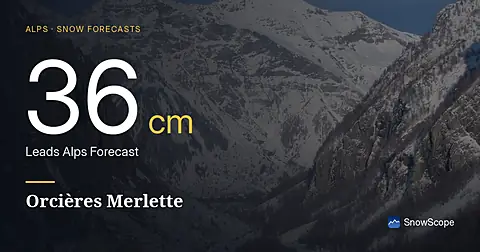
Orcières Merlette leads the Alps forecast with 36 cm of new snow in the next three days, mostly on November 9–10, based on data from November 7.
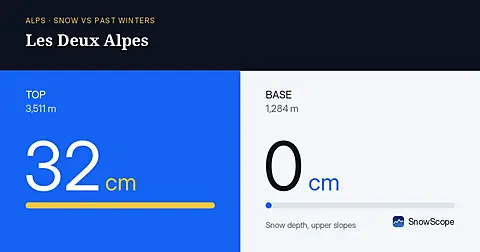
On 4 November, Les Deux Alpes has 45 centimetres at the summit but zero at the base—an extreme early-season height gap.