 SnowScope
Livigno checklist: ten practical things to know about Italy's cold high valley
Livigno is easy to love and easy to underestimate. The town stands at 1,816 m in a long valley of Lombardy close to the Swiss border, and it is cold. A little planning goes a long way. Here are ten practical points, in the order you will need them.
See the live snow forecast for Livigno in the SnowScope appSnow depth, powder alerts and the 3D map, free.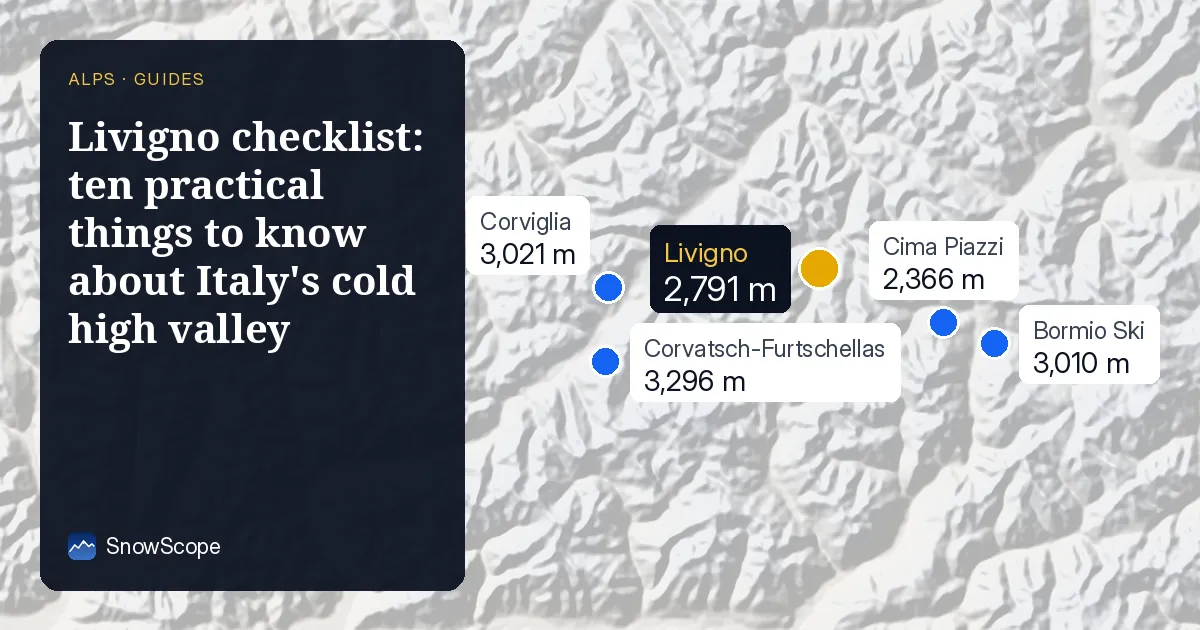
1. Pick your road before you pick your dates
Three roads lead to Livigno. The Foscagno pass, at 2,291 m, links it with the rest of Italy; the Munt la Schera tunnel connects it with Switzerland all year; and the Forcola di Livigno, at 2,315 m, is a summer-only road. In winter that leaves two ways in, and both are mountain routes, so check road conditions and carry chains or winter tyres.
2. Expect real cold
The valley has a subalpine climate, most of the winter is spent below freezing, and the record low is −37 °C. Pack a good mid-layer, a face cover and spare gloves; on a still January morning the valley floor can be colder than the slopes above it.
3. Know the two sides
The skiing is split between two sides of the valley: Carosello 3000 and Mottolino. Together they have about 115 km of pistes and 31 lifts. Plan your days by side rather than crossing the valley at lunch.
4. Height is on your side
Because the town is already so high, the snow starts close to your door. In our model of 46 past winters, the lowest point of the ski area, at 1,811 m, has a usual peak of about 65 cm. At 2,301 m, our middle point, it is about 116 cm, and near the top, at 2,791 m, about 207 cm.
5. Aim for February and March
At 2,301 m a typical winter has about 48 cm of snow in December, 74 cm in January, 91 cm in February, 96 cm in March and 92 cm in April. There are at least 50 cm there for 13 weeks in 9 winters out of 10, so the middle of the season is the safest bet.
6. Don't write off spring
Near the top, the snow keeps growing late: April is the deepest month at 2,791 m, with about 178 cm in a typical winter, and there are at least 50 cm for 22 weeks in 9 winters out of 10. On a sunny spring day ski the high runs before lunch.
7. Be careful with early December
The low runs are the weak point. At 1,811 m a typical winter has only about 29 cm in December, and in no week are there 50 cm in 9 winters out of 10. Early-season trips work best if you are happy to stay high.
8. Shop, but know the rules
Livigno has a long-standing tax-free status, with no value added tax on many goods. It goes back to around 1840, was confirmed by Italy around 1910 and again in 1960. If you plan to take goods home, check the customs allowances first.
9. A valley with an Olympic past
Livigno hosted the snowboard and freestyle skiing events of the 2026 Winter Olympics. Check on the official website which areas are open.
10. Read the snow, not just the forecast
The long-term picture here is steady at mid-mountain: our median peak at 2,301 m was about 117 cm in the first fifteen winters and about 122 cm in the last fifteen, although the days with snow on the ground fell from about 248 to 230. Last winter, 2025-26, was thin, with about 86 cm at mid-mountain. Check lifts on the official website and the regional avalanche bulletin before any off-piste day.
Tips for skiers
- Check the Foscagno pass or the Munt la Schera tunnel before you drive; the Forcola is closed in winter.
- Pack for deep cold: face cover, spare gloves, a warm mid-layer.
- For early-season trips, plan to ski high.
- Snow on our map does not mean a resort is open: check the lifts on the official website.
References and credits
- Wikipedia, 'Livigno', retrieved 8 November 2026: altitude, tax-free status, access roads and tunnel, climate, ski areas, 2026 Winter Olympics. en.wikipedia.org/wiki/Livigno
About these numbers
Snow numbers: SnowScope snow history, 46 past winters (1980-81 to 2025-26) at three heights of the resort, a model of the past corrected for height (an estimate for an area, not resort reports). Lift, run and access facts: the sources listed below, checked on the date shown.
Official avalanche bulletins: AINEVA
Cite this report
For research, teaching or the press: the numbers and charts are free to reuse under CC BY 4.0 with this citation.
SnowScope (2026), Livigno checklist: ten practical things to know about Italy's cold high valley, https://snowscope.app/blog/en/2026/11/livigno-practical-checklist-cold-high-valley-snow.html, accessed 2026-11-09
SnowScope (Atlas Labs). (2026, November 9). Livigno checklist: ten practical things to know about Italy's cold high valley. SnowScope snow reports. https://snowscope.app/blog/en/2026/11/livigno-practical-checklist-cold-high-valley-snow.html
BibTeX
@misc{snowscope2026livignopracticalchecklis,
  author       = {{SnowScope (Atlas Labs)}},
  title        = {Livigno checklist: ten practical things to know about Italy's cold high valley},
  year         = {2026},
  month        = nov,
  howpublished = {\url{https://snowscope.app/blog/en/2026/11/livigno-practical-checklist-cold-high-valley-snow.html}},
  note         = {Published 2026-11-09 19:48 UTC; accessed 2026-11-09}
}· CC BY 4.0 · Methods, data and tools →
Livigno: snow and temperature by height, this winter vs last (tools) →
Follow Livigno
Free: a message when fresh snow is coming, and the forecast every morning.

More snow reports
From 20 EUR on an opening weekend to 6-day passes before Christmas: a calendar of the cheapest early-season ski deals in the Alps for 2026, with the snow you can expect.
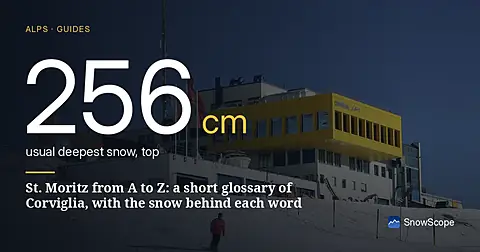
Chantarella, Marguns, Piz Nair, White Turf: the words you hear in St. Moritz, explained, and what 46 past winters of our snow history say about each height of Corviglia.
Kitzbühel is famous and low. What 46 past winters say about snow at 762 m, 1,377 m and 1,993 m, how it has changed, and which weeks are the safer bet.