 SnowScope
St. Moritz from A to Z: a short glossary of Corviglia, with the snow behind each word
St. Moritz has its own vocabulary. Visitors hear names like Chantarella, Marguns or Piz Nair on the first morning and nod politely. This glossary explains them in the order you are likely to meet them, and adds what our snow history, a model of 46 past winters, says about the height each word stands for.
See the live snow forecast for Corviglia in the SnowScope appSnow depth, powder alerts and the 3D map, free.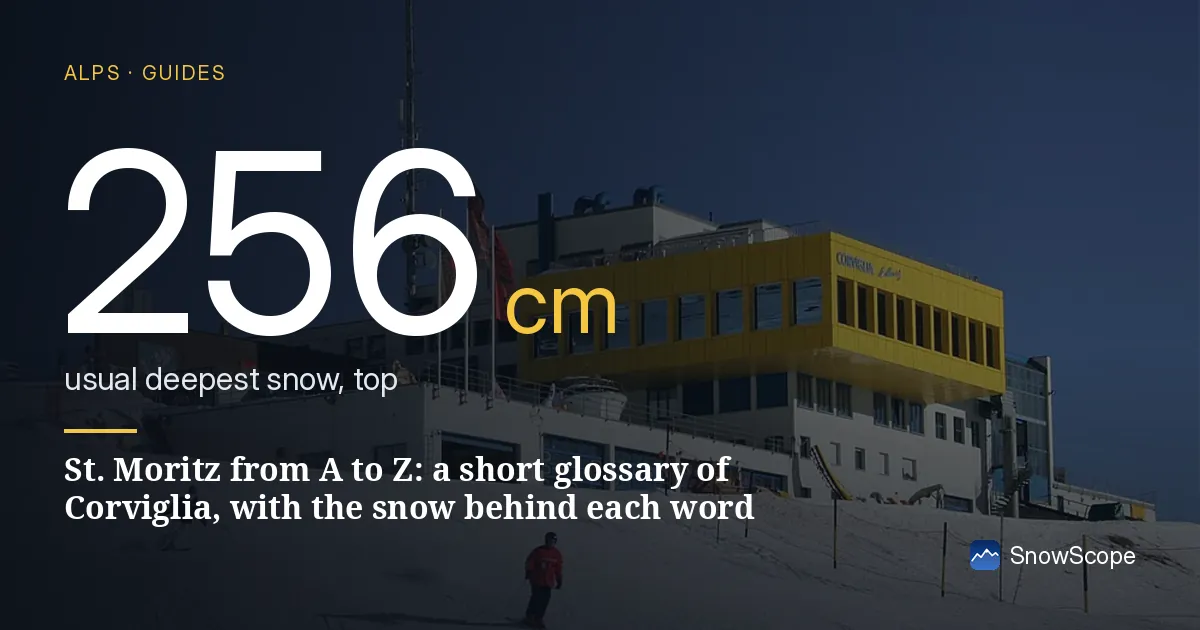
Engadin
The high valley in Graubünden where St. Moritz stands at about 1,800 m. Height is the theme of this whole glossary: the valley floor is already higher than many Alpine ski areas reach. Our lowest point for Corviglia, at 1,733 m, has a usual peak of only about 60 cm, though, so the valley is a place to start from, not a place to rely on for snow.
Chantarella
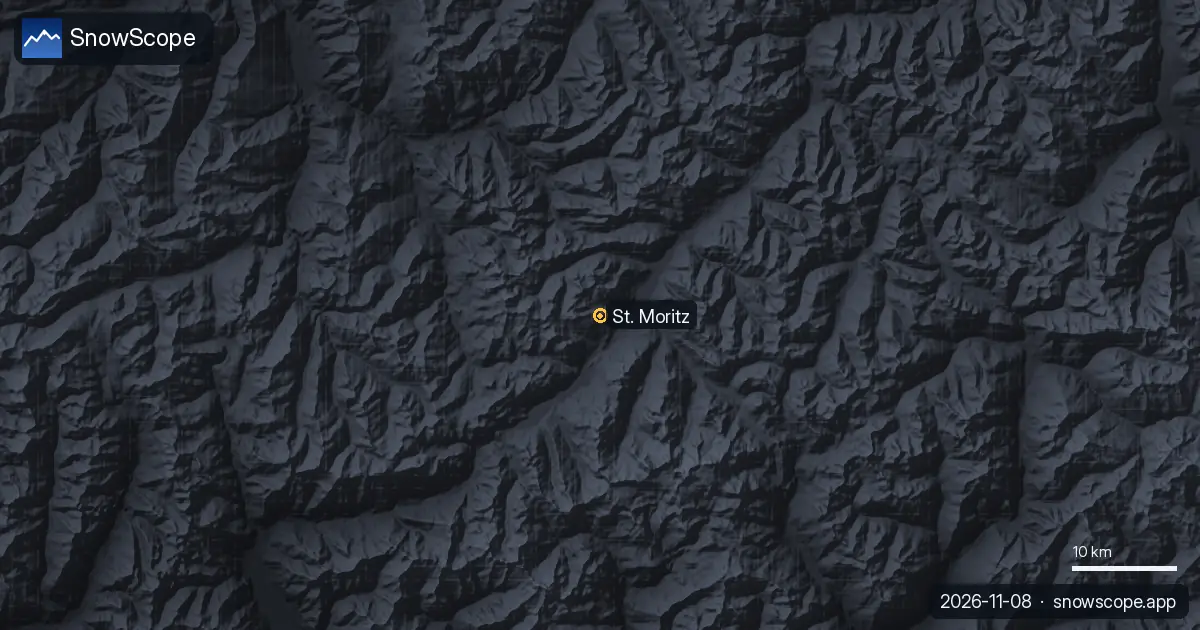
The middle station of the St. Moritz to Corviglia funicular. It is a useful word to know because it marks the step from town to mountain. Above it, the snow changes quickly.
Corviglia
The ski mountain itself, on the eastern slopes of Piz Nair above the town, at 2,486 m. Our middle point is close by, at 2,377 m. There, a typical winter has about 52 cm of snow in December, 82 cm in January, 98 cm in February, 105 cm in March and 108 cm in April, so the deepest month is late in the season. In 9 winters out of 10 there are at least 50 cm for 16 weeks. Corviglia hosted the alpine events of the 1948 Olympic Games and the World Championships of 1974 and 2003.
Marguns
The area above Celerina, linked to Corviglia. Together they form the largest skiing area in the Engadin. When you hear someone say they will ski down to Marguns, they mean the Celerina side of the same mountain.
Piz Nair
The summit above Corviglia, at 3,057 m, reached by an aerial tramway. This is the snow-sure end of the mountain. Near the top of our record, at 3,021 m, the usual peak is about 256 cm; in April a typical winter has about 211 cm and in May still about 203 cm. There are at least 50 cm there for 23 weeks in 9 winters out of 10.
Corvatsch
The other big ski mountain of the valley, rising to about 3,300 m with a piste of about 8 km down to St. Moritz-Bad. Worth a day when you want a change of view.
Bob Run
The natural bobsleigh run, a 1.72 km ice channel built again each winter. St. Moritz hosted the Winter Olympics twice, in 1928 and 1948, and the World Championships in 2017 too.
White Turf
Horse races on the frozen Lake St. Moritz, part of a calendar of lake events that also includes snow polo, held since 1985.
Sunshine
The town is said to enjoy over 300 days of sunshine a year. It is one reason the low slopes melt sooner than the cold upper ones, and why spring skiing here is best on the high ground.
Trend
Not a local word, but a useful one. At 2,377 m our median peak has hardly changed, about 130 cm in the first fifteen winters and about 133 cm in the last fifteen, but the days with snow on the ground fell from about 255 to 243. Near the top the median peak went from about 270 to 254 cm. Last winter, 2025-26, was thin: about 100 cm at mid-mountain and about 171 cm near the top.
Tips for skiers
- For the surest snow, plan your days around Piz Nair and the upper Corviglia slopes.
- Late season is a real option here: April is the deepest month at mid-mountain in our record.
- Read the SLF avalanche bulletin before any off-piste run.
- Snow on our map does not mean a resort is open: check the lifts on the official website.
References and credits
- Wikipedia, 'Corviglia', retrieved 8 November 2026: altitude, funicular via Chantarella, Piz Nair, Marguns, events. en.wikipedia.org/wiki/Corviglia
- Wikipedia, 'St. Moritz', retrieved 8 November 2026: altitude, Olympics, bob run, lake events, championships, sunshine, Corvatsch, railways. en.wikipedia.org/wiki/St._Moritz
- WSL Institute for Snow and Avalanche Research SLF, avalanche bulletin and snow situation for Switzerland. www.slf.ch/en/avalanche-bulletin-and-snow-situation/
About these numbers
Snow numbers: SnowScope snow history, 46 past winters (1980-81 to 2025-26) at three heights of the resort, a model of the past corrected for height (an estimate for an area, not resort reports). Lift, run and access facts: the sources listed below, checked on the date shown.
Official avalanche bulletins: WSL-SLF
Cite this report
For research, teaching or the press: the numbers and charts are free to reuse under CC BY 4.0 with this citation.
SnowScope (2026), St. Moritz from A to Z: a short glossary of Corviglia, with the snow behind each word, https://snowscope.app/blog/en/2026/11/st-moritz-corviglia-glossary-snow-engadin.html, accessed 2026-11-09
SnowScope (Atlas Labs). (2026, November 9). St. Moritz from A to Z: a short glossary of Corviglia, with the snow behind each word. SnowScope snow reports. https://snowscope.app/blog/en/2026/11/st-moritz-corviglia-glossary-snow-engadin.html
BibTeX
@misc{snowscope2026stmoritzcorvigliaglossar,
  author       = {{SnowScope (Atlas Labs)}},
  title        = {St. Moritz from A to Z: a short glossary of Corviglia, with the snow behind each word},
  year         = {2026},
  month        = nov,
  howpublished = {\url{https://snowscope.app/blog/en/2026/11/st-moritz-corviglia-glossary-snow-engadin.html}},
  note         = {Published 2026-11-09 11:38 UTC; accessed 2026-11-09}
}· CC BY 4.0 · Methods, data and tools →
Corviglia: snow and temperature by height, this winter vs last (tools) →
Follow Corviglia
Free: a message when fresh snow is coming, and the forecast every morning.

More snow reports
When to book Courchevel and the 3 Vallées, which village to stay in and where the snow lasts, planned from 46 past winters of snow data.
Cortina d'Ampezzo three ways: Tofana, Faloria-Cristallo and Cinque Torri-Lagazuoi, with 46 winters of snow data at three heights.
Our 46-winter Alps record at 108 points from 667 to 3,872 m: snow days down at all of them, clearly at 81 %. What changed at each height, and why.