 SnowScope
Park City Mountain, day one: a practical plan from the first lift to the car park
On a mountain this big, the first day is easy to waste in lift lines and on the wrong side of a ridge. This is the plan we would follow ourselves, plus what 46 past winters of our snow record (a model, not the resort's reports) say about where and when the snow is best.
See the live snow forecast for Park City Mountain Resort in the SnowScope appSnow depth, powder alerts and the 3D map, free.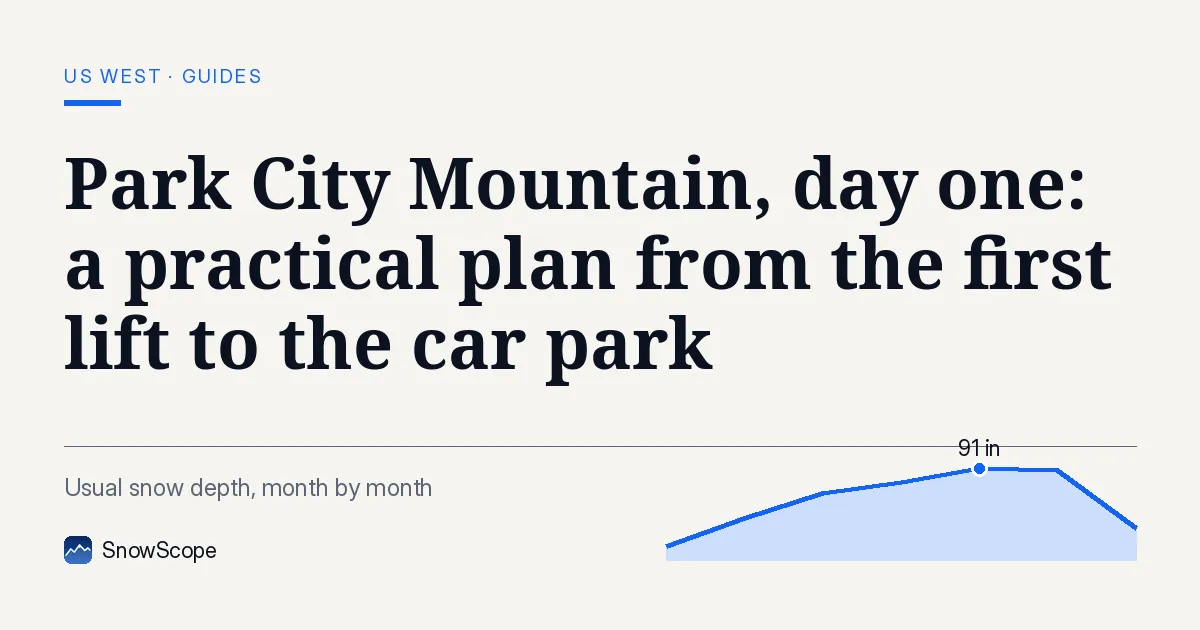
Know the scale before you clip in
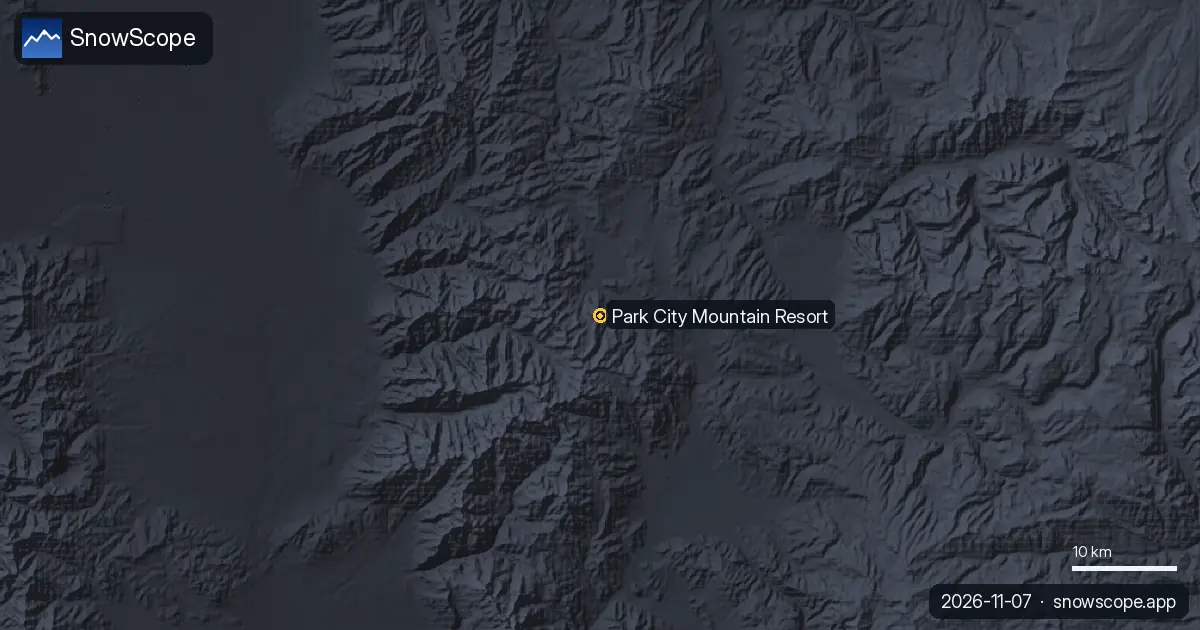
Since the Quicksilver Gondola joined it to Canyons in 2015, Park City has been the largest lift-served ski resort in the United States: about 6,700 acres and 41 lifts. Lifts climb from a base at 6,900 ft (2,100 m) to a top at 10,026 ft (3,056 m), a rise of 3,100 feet (945 m). Salt Lake City is only about 32 miles (51 km) to the west, so plenty of people land in the morning and ski the same day.
Forget about skiing all of it. Choose one side for the morning; at lunch, decide whether the other side is worth the trip.
First lifts: straight to the top
Go up high before anything else: that is where the snow is deepest and coldest. In our model the season usually peaks at about 111 in (281 cm) near the top, around 9,977 ft (3,041 m). Mid-mountain, around 8,435 ft (2,571 m), gets about 71 in (180 cm), and the base only about 42 in (106 cm). Start with a long groomed blue run up there; the lower slopes are still frozen hard from the night.
Mid-morning: let the sun do the work
The sun softens the east- and south-facing slopes first, while runs facing north keep cold, dry snow for longer. In dry mountains this is the first thing you learn. Intermediate skiers can chain bowls and ridges together without going down to the valley. Steeper terrain? Try it now, after a few runs have shown you how the snow behaves.
Lunch, then the other side
Avoid the noon crowd by eating early or late. With energy left, ride the Quicksilver Gondola across and explore the second side; tired legs are a good reason to stay on runs you already know. Make sure your last run ends close to your car or bus, because on a mountain this size the walk back can be long.
Which weeks to book
Our model's calendar for mid-mountain: November brings about 8 in (21 cm), December 26 in (67 cm), January 44 in (112 cm), February 55 in (140 cm) and March, the deepest month, 61 in (155 cm); April drops back to 48 in (121 cm). Higher up, near the top, March keeps about 91 in (230 cm) and April 88 in (224 cm). Mid-mountain held 20 in (50 cm) or more for 15 weeks, and that happened in 9 of every 10 winters.
Over the years the snow has thinned. Between the first 15 and the last 15 winters of the record, the usual mid-mountain peak fell to roughly 62 in (158 cm) from roughly 75 in (190 cm), and near the top to roughly 101 in (257 cm) from roughly 120 in (304 cm). At mid-mountain, 2025-26 came last of the 46 winters, peaking near 31 in (79 cm). February or March gives the safest cover.
Where to sleep, and what lies past the ropes
Beds at every price are in Old Town Park City and the base villages, and Salt Lake City is close enough to stay there and drive up each morning. Past the resort boundary, no patrol watches the slopes and avalanche terrain starts quickly: check the daily forecast from the Utah Avalanche Center, and bring a transceiver, shovel and probe.
Tips for skiers
- Start your day on the upper mountain: our model puts about twice as much snow there as at the base.
- Stick to one side of the mountain each morning; crossing back and forth eats the day.
- For the most reliable cover, book February or March.
- Heading past the boundary? The Utah Avalanche Center forecast comes first.
References and credits
- Wikipedia, 'Park City Mountain Resort' (retrieved 7 November 2026): elevations, vertical, skiable area, lifts, the Quicksilver Gondola link with Canyons, distance from Salt Lake City. en.wikipedia.org/wiki/Park_City_Mountain_Resort
- Utah Avalanche Center, official avalanche forecasts for the Salt Lake and Park City mountains. utahavalanchecenter.org/
About these numbers
Snow numbers: SnowScope snow history, 46 past winters (1980-81 to 2025-26) at three heights of the resort, a model of the past corrected for height (an estimate for an area, not resort reports). Lift, run and access facts: the sources listed below, checked on the date shown.
Official avalanche bulletins: Utah Avalanche Center
Cite this report
For research, teaching or the press: the numbers and charts are free to reuse under CC BY 4.0 with this citation.
SnowScope (2026), Park City Mountain, day one: a practical plan from the first lift to the car park, https://snowscope.app/blog/en/2026/11/park-city-mountain-first-day-plan.html, accessed 2026-11-09
SnowScope (Atlas Labs). (2026, November 9). Park City Mountain, day one: a practical plan from the first lift to the car park. SnowScope snow reports. https://snowscope.app/blog/en/2026/11/park-city-mountain-first-day-plan.html
BibTeX
@misc{snowscope2026parkcitymountainfirstday,
  author       = {{SnowScope (Atlas Labs)}},
  title        = {Park City Mountain, day one: a practical plan from the first lift to the car park},
  year         = {2026},
  month        = nov,
  howpublished = {\url{https://snowscope.app/blog/en/2026/11/park-city-mountain-first-day-plan.html}},
  note         = {Published 2026-11-09 21:44 UTC; accessed 2026-11-09}
}· CC BY 4.0 · Methods, data and tools →
Park City Mountain Resort: snow and temperature by height, this winter vs last (tools) →
Follow Park City Mountain Resort
Free: a message when fresh snow is coming, and the forecast every morning.

More snow reports

Heavenly, Sierra-at-Tahoe and Mt. Rose have more snow on 19 November than in any winter since 1980-81. How much fell, the measured gauges, the weather behind it and the best days to go.
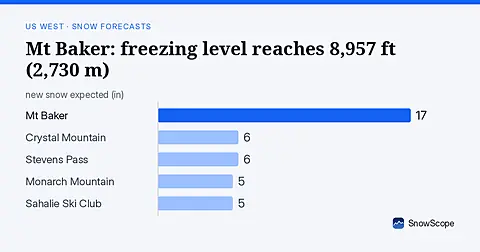
Rain will replace snow at Mt Baker on November 6, as the freezing level climbs to 8,957 ft (2,730 m), far above the ski area.
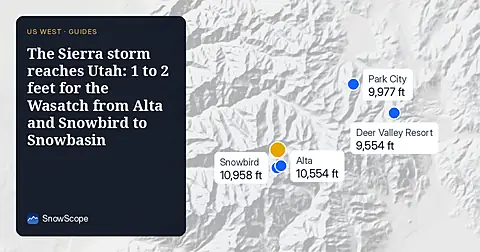
The National Weather Service expects 10 to 20 inches in the Wasatch from Thursday to Saturday. Where Utah's snowpack stands against past winters, why Utah snow is lighter, and when to ski.