 SnowScope
Vail by the numbers: snow depth, best months and the Back Bowls
Vail is a big mountain with big numbers, so this guide starts with them. Our snow history of 46 past winters (a model of the past, not resort reports) and the published facts of the mountain tell you when to come, which height to aim for and what to expect from the famous Back Bowls.
See the live snow forecast for Vail in the SnowScope appSnow depth, powder alerts and the 3D map, free.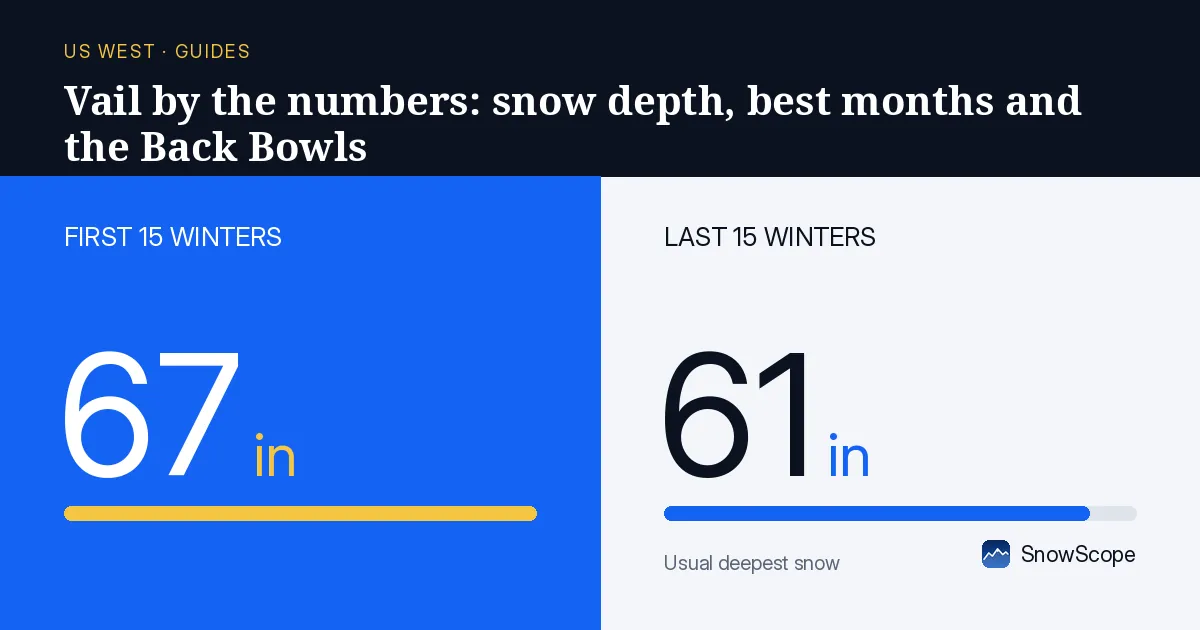
The mountain in a few numbers
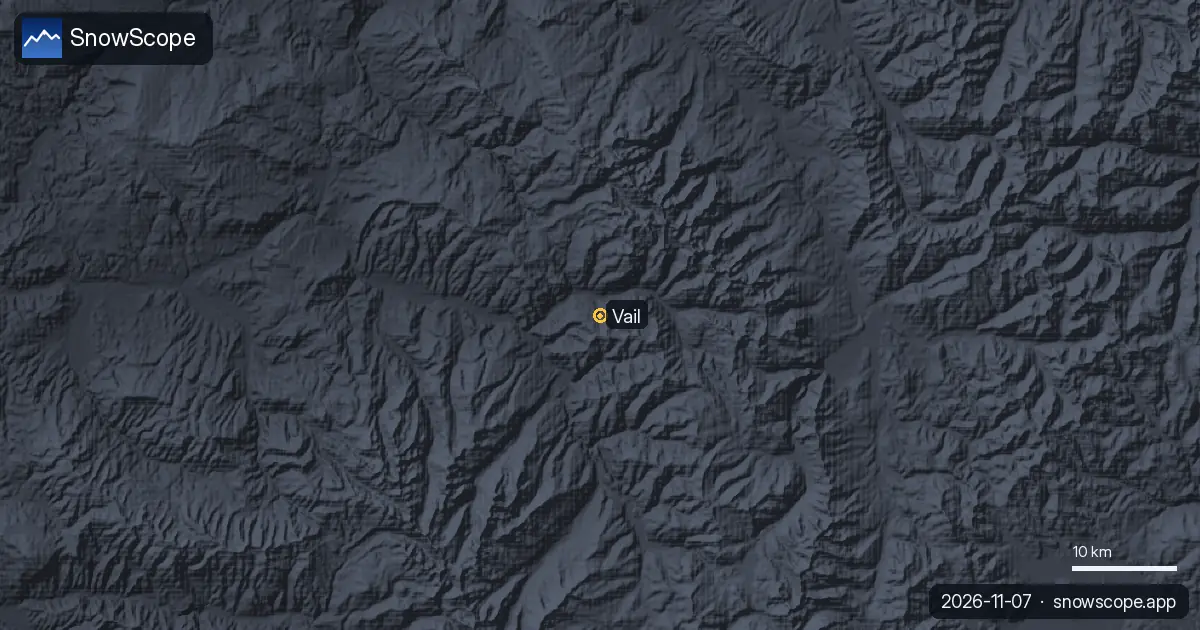
The summit stands at 11,570 ft (3,527 m) and the base at 8,120 ft (2,475 m), a vertical drop of 3,450 ft (1,052 m). The skiable area is 5,317 acres, which puts Vail among the largest single-mountain resorts in the United States.
The front side faces north and holds most of the groomed runs. Behind it lie the Back Bowls, wide open slopes such as Sun Down, China and Siberia, and further out Blue Sky Basin with its gladed intermediate terrain.
Snow by height
In our model the usual peak of the season is about 64 in (162 cm) at mid-mountain, around 9,806 ft (2,989 m), and about 88 in (223 cm) near the top, at 11,568 ft (3,526 m). Near the base, at about 8,045 ft (2,452 m), it is only about 31 in (78 cm). The upper half of the mountain carries the season.
Snow builds slowly. At mid-mountain the usual depth is about 10 in (25 cm) in November, 24 in (62 cm) in December, 39 in (98 cm) in January, 47 in (120 cm) in February and 54 in (136 cm) in March, the deepest month. April still keeps about 44 in (111 cm).
How many snow-sure weeks?
We call a week good when at least 20 in (50 cm) lies on the ground. At mid-mountain that was the case in 9 of 10 winters for 15 weeks of the season, near the top for 21 weeks. In plain words: from January to April the upper half of Vail almost always has a solid cover, while December can be good but is less certain, especially low down.
Then and now
Our model also compares the first 15 winters of the record with the last 15. At mid-mountain the usual peak fell from about 67 in (171 cm) to about 61 in (154 cm), and the number of days with snow on the ground from 230 to 219. Last winter, 2025-26, was a lean one: the peak at mid-mountain reached only about 38 in (96 cm), close to the lowest of the 46 winters.
Getting there and staying
Vail lies about 100 miles (160 km) west of Denver on Interstate 70, and the nearest airport is Eagle County Regional Airport. On I-70 between Morrison and Dotsero, Colorado's traction law can apply from September to May: in a storm your car needs suitable tires or chains.
Staying in the village means walking to the lifts; the towns further down the valley are usually cheaper and linked by road. Book early for the Christmas holidays and February, the busiest weeks.
Safety in the bowls and beyond
The Back Bowls are inside the ski area, but they are steep and open, and after a storm they need care. Beyond the boundary there is no patrol. Before any backcountry trip, read the daily forecast of the Colorado Avalanche Information Center and carry a transceiver, probe and shovel.
Tips for skiers
- Aim for the upper mountain early in the season: our model gives it about three times the snow of the base.
- For the deepest and most reliable cover, plan your trip between February and early April.
- Check the traction law and road conditions before you drive I-70 from Denver.
- Off-piste or outside the boundary: read the official avalanche forecast first.
References and credits
- Wikipedia, 'Vail Ski Resort' (retrieved 7 November 2026): elevations, vertical drop, skiable area, Back Bowls, Blue Sky Basin, Interstate 70, Eagle County Regional Airport. en.wikipedia.org/wiki/Vail_Ski_Resort
- Colorado Department of Transportation, 'Traction Law' (retrieved 7 November 2026): I-70 from Morrison to Dotsero, September to May. www.codot.gov/travel/winter-driving/tractionlaw
- Colorado Avalanche Information Center (CAIC), official avalanche forecasts for Colorado. avalanche.state.co.us/
About these numbers
Snow numbers: SnowScope snow history, 46 past winters (1980-81 to 2025-26) at three heights of the resort, a model of the past corrected for height (an estimate for an area, not resort reports). Lift, run and access facts: the sources listed below, checked on the date shown.
Official avalanche bulletins: Colorado Avalanche Information Center
Cite this report
For research, teaching or the press: the numbers and charts are free to reuse under CC BY 4.0 with this citation.
SnowScope (2026), Vail by the numbers: snow depth, best months and the Back Bowls, https://snowscope.app/blog/en/2026/11/vail-ski-resort-snow-in-numbers.html, accessed 2026-11-10
SnowScope (Atlas Labs). (2026, November 10). Vail by the numbers: snow depth, best months and the Back Bowls. SnowScope snow reports. https://snowscope.app/blog/en/2026/11/vail-ski-resort-snow-in-numbers.html
BibTeX
@misc{snowscope2026vailskiresortsnowinnumbe,
  author       = {{SnowScope (Atlas Labs)}},
  title        = {Vail by the numbers: snow depth, best months and the Back Bowls},
  year         = {2026},
  month        = nov,
  howpublished = {\url{https://snowscope.app/blog/en/2026/11/vail-ski-resort-snow-in-numbers.html}},
  note         = {Published 2026-11-10 07:53 UTC; accessed 2026-11-10}
}· CC BY 4.0 · Methods, data and tools →
Vail: snow and temperature by height, this winter vs last (tools) →
Follow Vail
Free: a message when fresh snow is coming, and the forecast every morning.

More snow reports
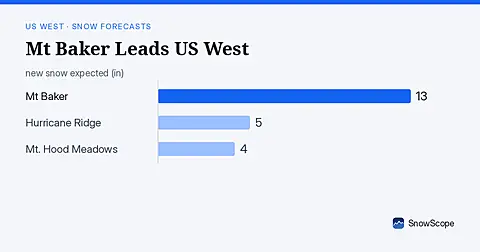
Mt Baker leads the US West with 19 in (47 cm) of upper snow, expecting 13 in (33 cm) through November 9. Model forecast from November 6.
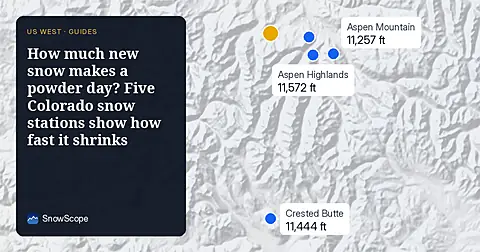
A storm on November 4 left 8 to 13 inches of new snow at five high Colorado stations near Aspen. Five days later, half of it was gone. What that means for powder days.
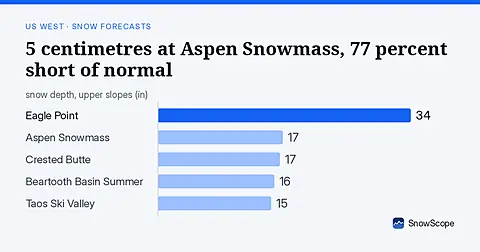
Aspen Snowmass at 5 centimetres, 23 percent of normal for mid-November. Freezing levels above 2,600 metres brought rain instead of snow across the US West on November 8.