 SnowScope
Does a snowy November mean a big winter? We tested it on 46 winters
Every autumn the same hope comes back: lots of snow early, so it must be a big year. Others worry the other way: a brown November, so the winter is lost. We tested both ideas on 46 winters at 46 ski resorts in the Alps, the Pyrenees, the US West and western Canada. The answer is a careful yes for the Alps and Canada, and a clear "not really" for the Pyrenees.
See the live snow forecast for Revelstoke in the SnowScope appSnow depth, powder alerts and the 3D map, free.
The test
Think of the snowpack as a water tank on the mountain. It fills from autumn to late winter and empties in spring. The question is simple: does an early fill tell you how full the tank will be at its highest point?
For each resort we took two numbers per winter, at the top of the ski area: the snow depth on 10 November, and the deepest snow of that winter. Then we sorted the 46 Novembers into three groups: the snowiest third (16 winters), a middle group, and the thinnest third. Finally we counted how often each group went on to a big winter, which here means a peak deeper than that resort's usual peak.
If November told you nothing, both the snowy and the thin group would reach a big winter about half of the time. That 50 % is the line to beat.
The result: a head start, not a promise
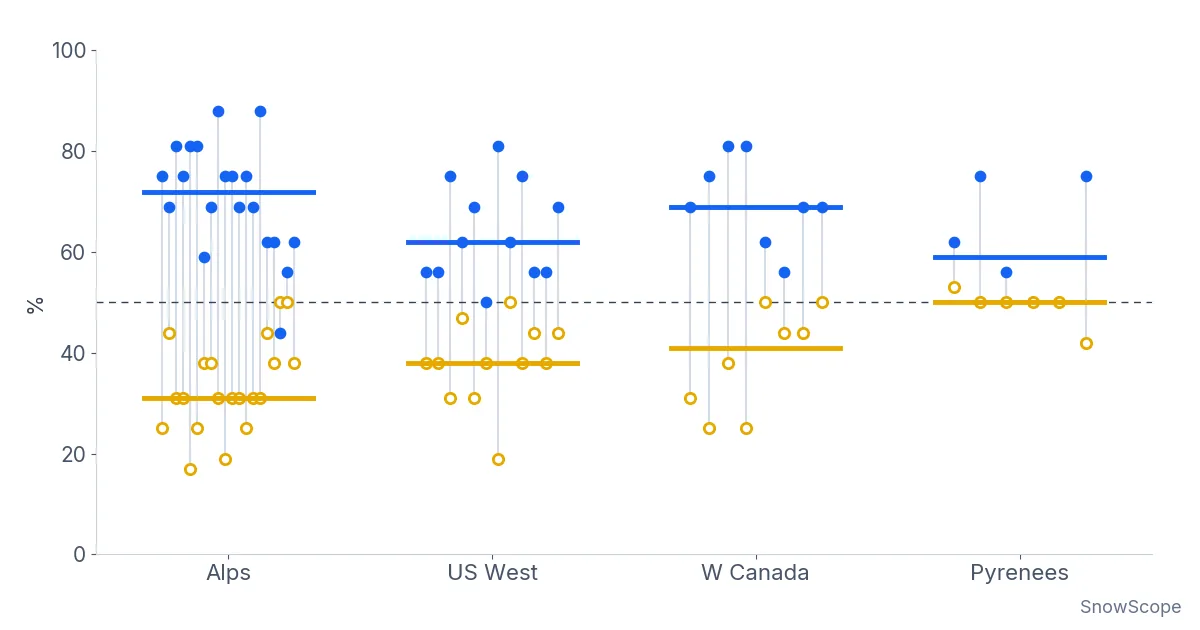
Across all 46 resorts, the middle resort reached a big winter in 69 % of the winters that began with a snowy November. After a thin November, it was 38 %. That is a real difference. It is also far from certain: more than one thin start in three still turned into an above-normal winter, and almost one snowy start in three did not.
We also measured how closely the two numbers move together, on a scale from 0 (no link) to 1 (a perfect link). The middle resort scores 0.33. In everyday language: a weak to moderate link. November snow shifts the odds, it does not decide them.
Big differences between regions
The Alps show the clearest signal. Across 20 Alpine resorts, a snowy November led to a big winter in 72 % of cases, a thin one in only 31 %. At Zermatt the link is the strongest in our test (0.65): 81 % big winters after a snowy start, 17 % after a thin one. Livigno (0.62) and Sestriere and Val Thorens, both at 88 % after a snowy November, tell a similar story.
Western Canada comes next. Revelstoke has a link of 0.62: big winters followed 75 % of its snowy Novembers and 25 % of its thin ones. Lake Louise and Banff Sunshine both reach 81 % after a snowy start. Across the 8 Canadian resorts, the middle values are 69 % and 41 %.
The US West is weaker: 62 % against 38 % for the middle of 12 resorts. Telluride (0.54) has a clear signal; Mt Baker, one of the snowiest places in our list, has almost none (0.12).
The Pyrenees break the rule. Here the middle values are 59 % and 50 %, and the link is almost zero at Formigal (0.04) and Gourette (0.06). The reason is the water itself: in the Pyrenees, early snow often melts again in the warm spells that follow, and most of the snow that counts comes later, in big Atlantic or Mediterranean storms.
Why the link is stronger in some places
Two things make November matter. The first is cold. Where the top of the ski area stays well below freezing from November on, early snow simply stays and becomes part of the base. Zermatt's top at 3,872 m and Revelstoke's at 2,224 m in the cold interior of British Columbia are such places. The early snow is part of the final total.
The second is the weather pattern. Some autumns set up a pattern of storms that lasts for weeks. When that happens, a snowy November and a snowy December belong to the same story.
Where neither is true, the link breaks. At KitzSki (top 1,993 m) the score is 0.04. Early snow at that height comes and goes, and the winter is decided by what falls from late December onwards.
How sure can we be?
Each resort has only 46 winters, and each group holds about 16 of them. One or two unusual winters can move a percentage by several points. Read the numbers as a tendency, not a forecast.
We used the top of each ski area because November snow is often missing at mid-mountain. On a few glaciers, part of the November snow can be old snow from the year before, which makes the link look stronger than it is. So we repeated the test at mid-mountain. The link is a little weaker there: 0.28 for the middle resort instead of 0.33. The direction stays the same.
These are model values for past winters, not resort reports, and they cover natural snow only.
What it means for this winter
If your resort had a snowy start, enjoy it: the odds of a big winter are better than usual, especially in the Alps and in Canada. If November is thin where you want to ski, do not cancel anything yet. In our test, a thin November was followed by a big winter about four times out of ten in the US West and in Canada, and about three times out of ten in the Alps.
The tank is not full on 10 November. It fills mostly in December, January and February, and that part of the story has not been written yet.
Tips for skiers
- A snowy November improves the odds of a big winter, but it is not a forecast.
- A thin November is a reason to book later or flexibly, not to give up on the season.
- In the Pyrenees, ignore November snow when you try to guess the winter.
- Early-season snow often forms weak layers: check the official avalanche bulletin before skiing off-piste.
References and credits
- SnowScope: Where to ski this winter 2026/27 – snow reliability by region. snowscope.app/blog/en/2026/11/where-to-ski-winter-2026-27-snow-reliability-by-region.html
- SnowScope: How accurate is our snow depth map? First check against 2,012 stations. snowscope.app/blog/en/2026/11/how-accurate-is-our-snow-depth-map-november-2026.html
About these numbers
Snow numbers: SnowScope snow history, 46 past winters (1980-81 to 2025-26) at the top height of 46 resorts (20 Alps, 12 US West, 8 western Canada, 6 Pyrenees), a model of the past corrected for height (natural snow, not resort reports). Link = rank correlation between the depth on 10 November and the winter's deepest snow; big winter = peak above the resort's median peak; snowy / thin = top / bottom third of the 46 Novembers.
Cite this report
For research, teaching or the press: the numbers and charts are free to reuse under CC BY 4.0 with this citation.
SnowScope (2026), Does a snowy November mean a big winter? We tested it on 46 winters, https://snowscope.app/blog/en/2026/11/does-a-snowy-november-mean-a-big-winter-46-winters.html, accessed 2026-11-10
SnowScope (Atlas Labs). (2026, November 10). Does a snowy November mean a big winter? We tested it on 46 winters. SnowScope snow reports. https://snowscope.app/blog/en/2026/11/does-a-snowy-november-mean-a-big-winter-46-winters.html
BibTeX
@misc{snowscope2026doesasnowynovembermeanab,
  author       = {{SnowScope (Atlas Labs)}},
  title        = {Does a snowy November mean a big winter? We tested it on 46 winters},
  year         = {2026},
  month        = nov,
  howpublished = {\url{https://snowscope.app/blog/en/2026/11/does-a-snowy-november-mean-a-big-winter-46-winters.html}},
  note         = {Published 2026-11-10 21:14 UTC; accessed 2026-11-10}
}· CC BY 4.0 · Methods, data and tools →
Revelstoke: snow and temperature by height, this winter vs last (tools) →
Follow Revelstoke
Free: a message when fresh snow is coming, and the forecast every morning.

More snow reports
Mt Baker: 8 in (21 cm) at the summit versus less than 1 in (2 cm) at the base. November forecast shows how this height gap will shift.
Whistler Blackcomb gained 24 cm in one week to 50 cm total; 62 cm more forecast in 72 hours as major storms hit mountains (8 November data).
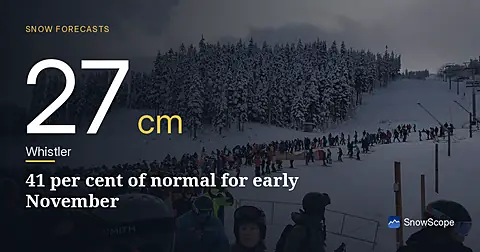
Whistler Blackcomb sits at 27 cm on 5 November, only 41 per cent of normal for this date. A major system brings 22 cm snow in the next 24 hours.