 SnowScope
Lech and Zürs, then and now: a ski history in dates, and what 46 winters of snow say
Lech and Zürs are two high villages on the Arlberg, in Vorarlberg, that helped invent Alpine skiing as a holiday. Their story reads best as a timeline. At the end of it we put our own timeline, the snow of 46 past winters from our model at three heights, then and now.
See the live snow forecast for Lech/Zürs in the SnowScope appSnow depth, powder alerts and the 3D map, free.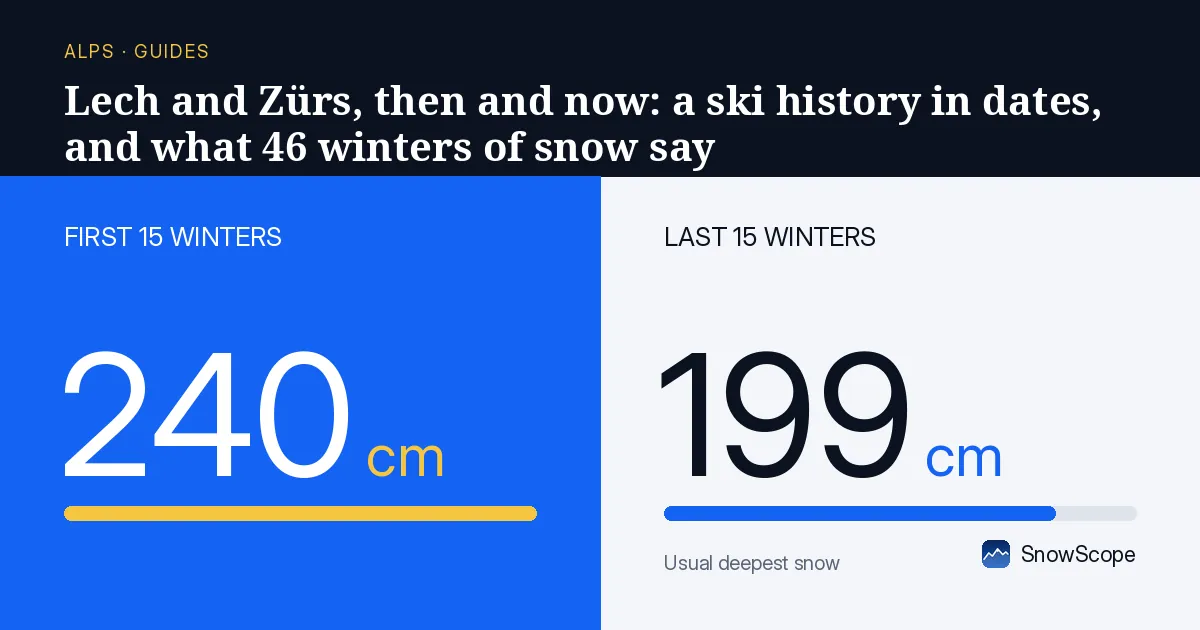
13th century: the Walser arrive
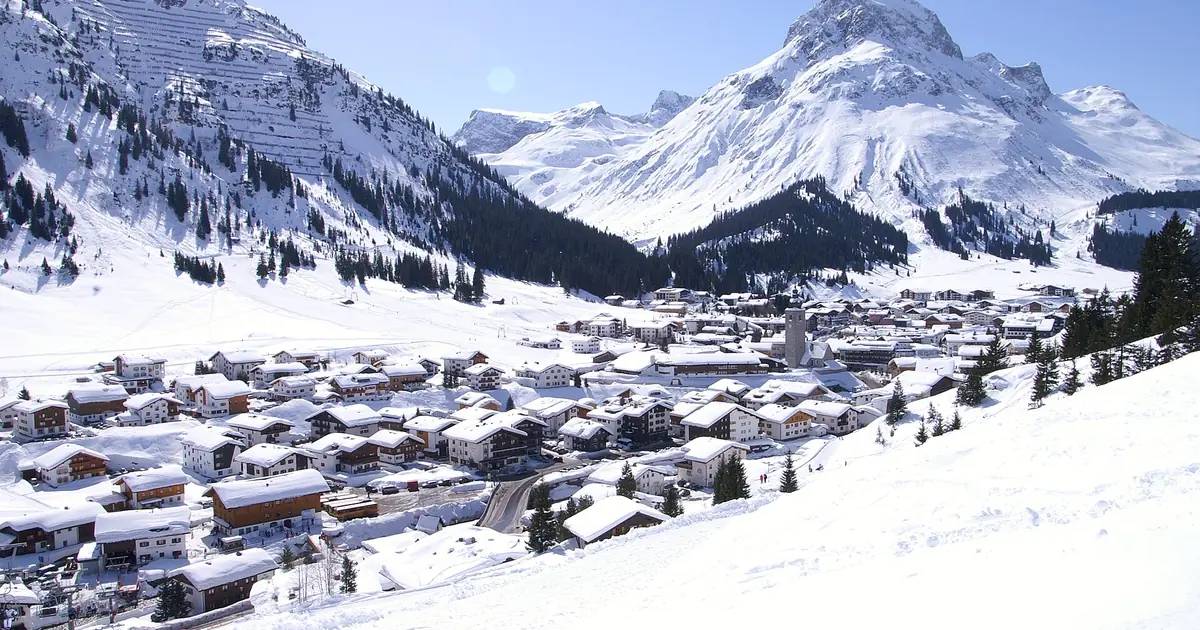
Lech was settled in the first half of the 13th century by Walser migrants from the Valais in Switzerland. The old church, on a hill, stands at 1,444 m. Zürs, higher up near the Flexen pass, lies at 1,716 m. These were farming places long before anyone came for the snow.
1897 to 1906: a road and a ski course
In 1897 a road over the Flexen pass connected Zürs to the rest of Vorarlberg and Austria. The first skiing course was held in Zürs in 1906, and over the next decades hotels and guesthouses followed.
1937 to 1940: the first lifts
In 1937 Austria's first T-bar lift was built on the practice slope in Zürs. Lech opened its first lift in 1939, and in 1940 the first ski lift was built on what would become the White Ring.
1957 to 2016-17: the circuit and the link
The Rüfikopf cable car, completed in 1957, gave a ski link between Lech and Zürs and made the White Ring possible: a circuit through Lech, Zürs, Zug and Oberlech of about 22 km, often called the longest ski circuit in the world. Its race was first held in 2006. In the 2016-17 season the Flexenbahn linked Zürs with Stuben, joining the Arlberg into one area that the source describes as the largest in Austria, with 88 lifts and 304 km of pistes. Lech Zürs also caps the number of ski tickets it sells, which keeps the slopes calmer than the size suggests.
Then: the first fifteen winters
Our record starts in 1980-81. In its first fifteen winters, mid-mountain at 1,933 m reached a median peak of about 240 cm, with snow on the ground for about 253 days. Near the top, at 2,436 m, the median peak was about 351 cm, and at the bottom, at 1,430 m, about 89 cm.
Now: the last fifteen winters
In the last fifteen winters, up to 2025-26, the same mid-mountain point peaked at about 199 cm, with about 229 days of snow on the ground. The top fell to about 323 cm and the bottom to about 75 cm. That is a clear loss, largest in the middle of the mountain. Last winter, 2025-26, was still below the long-term normal at mid-mountain, with a peak of about 181 cm, and below it at the top too, at about 293 cm.
What has not changed
Even after that loss, Lech Zürs remains one of the snowier places in our Alpine record. Over all 46 winters, a typical winter at mid-mountain has about 111 cm in January, 163 cm in February, 178 cm in March and 160 cm in April, and in 9 winters out of 10 there were at least 50 cm for 18 weeks; near the top, for 25 weeks. For the deepest snow, come from February to April. Off the pistes, read the Vorarlberg avalanche bulletin first, and check lifts and dates on the official website before you travel.
Tips for skiers
- February to April is the deepest part of the season at mid-mountain.
- Ski tickets are capped: on busy weeks, buy early.
- Off-piste: read the Vorarlberg avalanche bulletin and go with a guide.
- Snow on our map does not mean a resort is open: check lifts and dates on the official website.
References and credits
- Wikipedia, 'Lech, Vorarlberg' (Lech am Arlberg), retrieved 8 November 2026: Walser settlement, church height, lifts of 1939 and 1940, White Ring, Flexenbahn, Ski Arlberg size. en.wikipedia.org/wiki/Lech_am_Arlberg
- Wikipedia, 'Zürs', retrieved 8 November 2026: height, Flexen pass road of 1897, first ski course of 1906, first T-bar lift of 1937, Rüfikopf cable car of 1957. en.wikipedia.org/wiki/Z%C3%BCrs
- Lech Zürs am Arlberg, official website (Walser village, ski ticket cap), retrieved 8 November 2026. www.lechzuers.com/en
- Land Vorarlberg, avalanche warning service (Lawinenwarndienst Vorarlberg). www.vorarlberg.at/lawine
About these numbers
Snow numbers: SnowScope snow history, 46 past winters (1980-81 to 2025-26) at three heights of the resort, a model of the past corrected for height (an estimate for an area, not resort reports). Lift, run and access facts: the sources listed below, checked on the date shown.
Official avalanche bulletins: EAWS – European Avalanche Warning Services
Cite this report
For research, teaching or the press: the numbers and charts are free to reuse under CC BY 4.0 with this citation.
SnowScope (2026), Lech and Zürs, then and now: a ski history in dates, and what 46 winters of snow say, https://snowscope.app/blog/en/2026/11/lech-zuers-then-and-now-ski-history-snow.html, accessed 2026-11-09
SnowScope (Atlas Labs). (2026, November 9). Lech and Zürs, then and now: a ski history in dates, and what 46 winters of snow say. SnowScope snow reports. https://snowscope.app/blog/en/2026/11/lech-zuers-then-and-now-ski-history-snow.html
BibTeX
@misc{snowscope2026lechzuersthenandnowskihi,
  author       = {{SnowScope (Atlas Labs)}},
  title        = {Lech and Zürs, then and now: a ski history in dates, and what 46 winters of snow say},
  year         = {2026},
  month        = nov,
  howpublished = {\url{https://snowscope.app/blog/en/2026/11/lech-zuers-then-and-now-ski-history-snow.html}},
  note         = {Published 2026-11-09 18:13 UTC; accessed 2026-11-09}
}· CC BY 4.0 · Methods, data and tools →
Lech/Zürs: snow and temperature by height, this winter vs last (tools) →
Follow Lech/Zürs
Free: a message when fresh snow is coming, and the forecast every morning.

More snow reports
Seven days in the Silvretta Arena, one at a time: where the snow is, when to cross to Samnaun, and what 46 past winters say about Ischgl's snow at three heights.
Davos and Klosters share six ski mountains. A day-by-day plan, starting on Parsenn, with what 46 past winters of our snow history say about its heights.
When to book Courchevel and the 3 Vallées, which village to stay in and where the snow lasts, planned from 46 past winters of snow data.